Whilst the global AI race is often characterised by closed systems, a new collaboration between UiA and Kommuneforlaget AS (KF) is taking a different direction.
The solution is not a direct competitor to tools such as Claude, ChatGPT and Gemini, but a national tool for safe and comprehensible AI solutions. Of particular importance is the ability to explain why a decision is made, something for which public administration has a great need.
"In a geopolitically unstable situation, it is important that we in Norway develop and use technological solutions that make us less dependent on the major Big Tech companies. By making our AI research openly available as free software, we and KF are contributing directly to innovation, transparency and secure digitalisation in the public sector, says Sunniva Whittaker", rector at UiA.
This is the Tsetlin machine:
- Developed by Professor Ole-Christoffer Granmo at the University of Agder, first launched in 2018
- Not a physical machine, but a machine learning algorithm – a piece of code for artificial intelligence
- Based on logic rather than data-driven machine learning: the algorithm uses so-called Tsetlin automata to learn patterns through logical rules
- Can explain why it makes a decision – unlike traditional deep learning (‘black box’)
- Recognised by researchers worldwide as simpler and more precise than deep learning
- Green technology: particularly suited to energy-efficient hardware with very low energy consumption
- Competitive across a range of tasks, including classification, text comprehension and speech
- Free and accessible to all – developed as a democratic alternative to the closed systems of the major tech companies
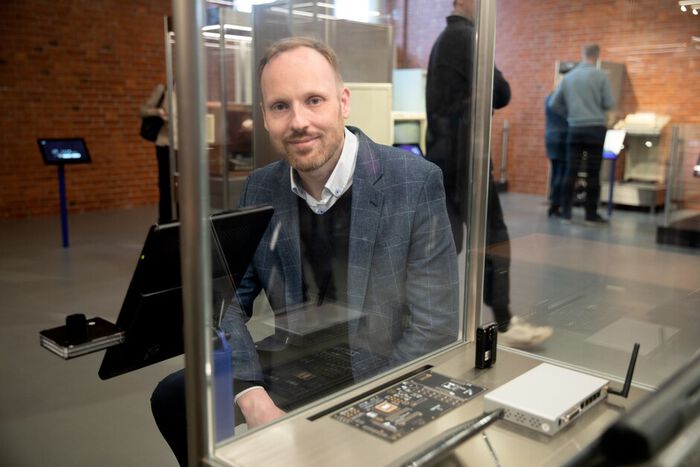
- Part of the permanent exhibition at the Norwegian Museum of Science and Technology
Source: Cair.uia.no
From ambition to action in the public sector
By 2026, the government has shifted its focus on AI from ambition to implementation, partly through the establishment of AI Norway. At the same time, the Office of the Auditor General has emphasised the need for better coordination and stronger implementation in the government’s use of AI.
“We want to make Norwegian AI research easily and freely accessible to local authorities, public sector organisations and others who need explainable, verifiable and practically applicable artificial intelligence,” says Sven-Olav Svendsen, Chief Executive of KF.
Democratising access to AI
The Tsetlin engine was developed by UiA professor Ole-Christoffer Granmo and was first launched in 2018. It has since gained international attention as a logic-based and explainable approach to AI.
“The Tsetlin technology has been developed to combine learning, transparency and efficiency. The fact that this research is now being made easier to use as free software is important for innovation, verifiability and broader societal benefit,” says Granmo.
Granmo is head of UiA’s Centre for Artificial Intelligence Research (CAIR), which is now collaborating with KF.
To lower the barrier to moving from research to practical testing, they are launching the components KF Fuzzy Tsetlin and KF Graph Tsetlin – both based on Tsetlin machine technology. These make it easier to apply the methods in Langflow – a free, web-based environment that allows users to build AI workflows without writing code from scratch.
Read the full press release from the organisations involved (in Norwegian)
-
Millions for student activities and AI support June 23, 2026 2:30 PM
-
AI tool for grade explanations now available to all staff June 5, 2026 9:33 AM