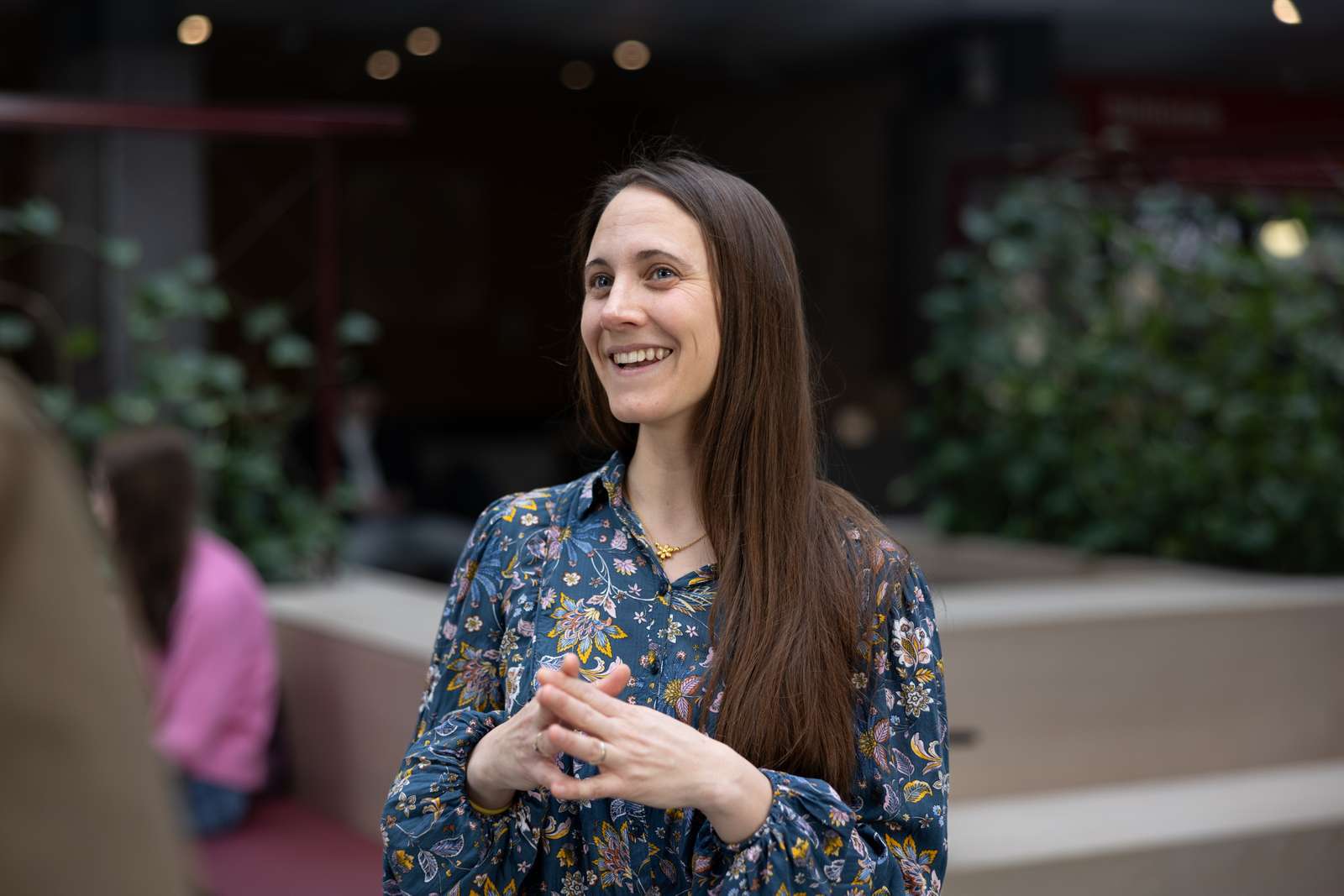
“It was unexpected, and I’m looking forward to getting started on the research,” says Heidi Klockmann, Associate Professor at the University of Agder.
“This is yet another feather in the cap for humanities researchers at the University of Agder. Heidi Klockmann will now carry out fundamental research that can help us better understand how humans describe and make sense of the world,” says Espen Klævik-Pettersen.
He is Head of Department at the University of Agder’s Department of Foreign Languages and Translation, and notes that last year too, a young researcher at the Faculty of Humanities and Education received the same distinction.
Funding for groundbreaking researchers
The Research Council of Norway is behind the awards to what it calls groundbreaking researchers. This time, a total of 236 million kroner is being allocated across 22 research projects. Klockmann receives 10 of those millions. She is awarded the funding under the Early Career Researcher scheme (FRIPRO).
Mari Sundli Tveit is the Director General of the Research Council of Norway. In a press release about the awards, she says:
“Groundbreaking research is particularly important for advancing the field. The Research Council is making targeted investments in both early-career researchers and established scholars to build excellence in research.”
Breaking the rules of grammar
Klockmann’s research will focus on what happens when a word behaves differently from what its grammatical category would suggest. In the phrase “heaps of questions”, “heaps” still looks like a noun, but in fact functions as a word indicating quantity, similar to “many”.
Two traditions in linguistics have long been in opposition: generative linguistics holds that word classes are sharply distinct, while cognitive-functional linguistics argues that the boundaries are fluid.
Klockmann aims to show that these traditions are not simply opposites, but that they complement each other and explain different aspects of language.
Developing a new theory of word classes
“My aim is to develop a new theory of language and word classes that incorporates insights from both traditions, and that expands our understanding of word classes by looking at words operating right at the edge of their own category,” she says.
The project will examine such borderline cases in English, Norwegian, Spanish, Polish, and another language yet to be selected.
Klockmann will begin the new research project in September. In the new year, she will hire a PhD fellow. She already has agreements with colleagues at the University of Agder who will contribute to the project.
“We are of course delighted and proud of this project. In addition to securing research funding and an important new project at the University of Agder, we also receive additional resources beyond the 10 million. This will further help develop our academic fields,” says Klævik-Pettersen.