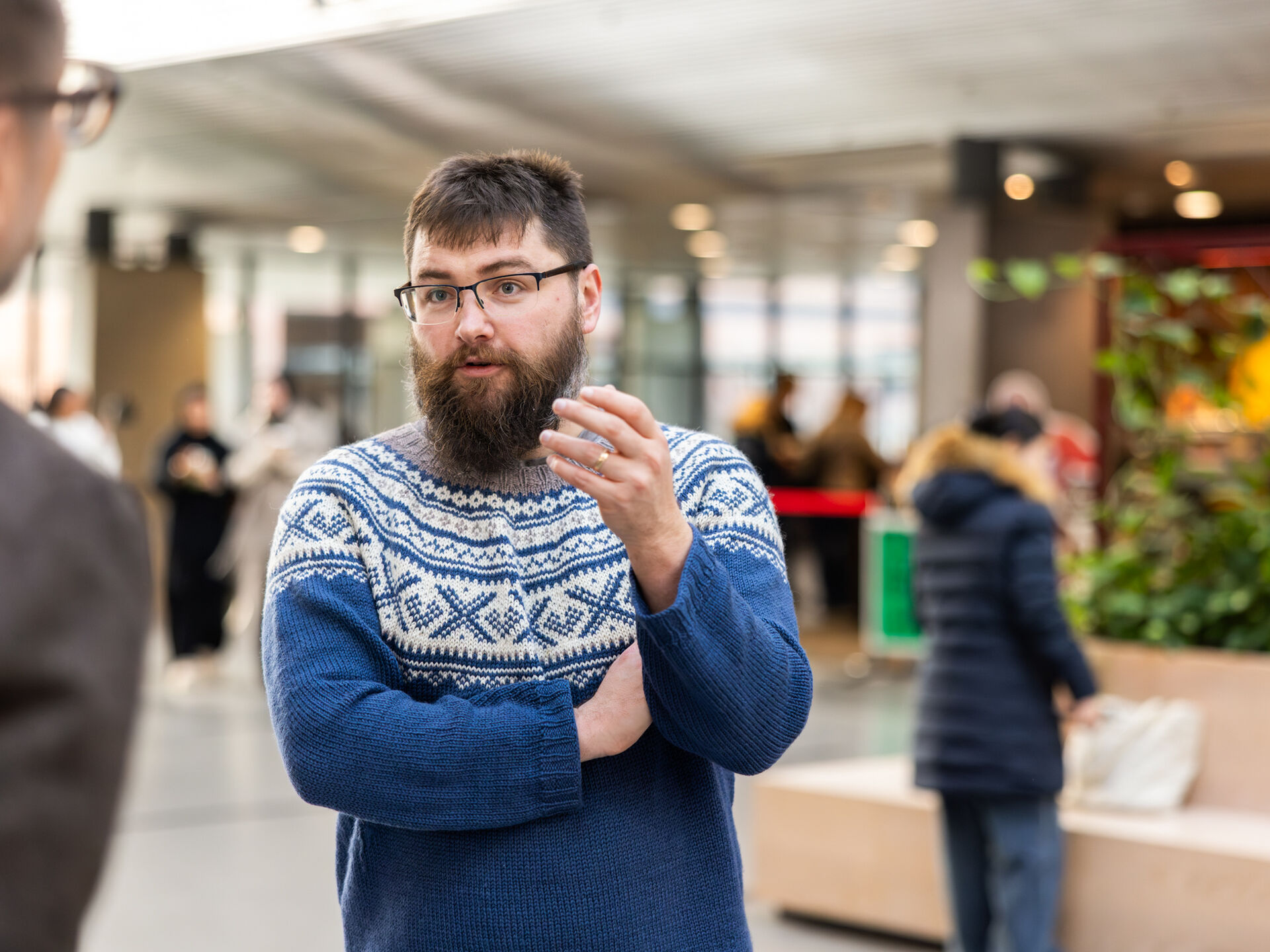
The award from the Research Council's scheme for groundbreaking research carries great prestige in all research communities in Norway.
But Joseph Scales has not quite taken it in yet.
"I was surprised, and I don't know if I've had time to feel happy yet, but of course I am," says Joseph Scales.
"It's certainly something to be proud of. It's not every day a young researcher is awarded 10 million kroner for what we must call a classic humanities research project: reading, interpreting and writing about ancient texts."
So says Professor Gunhild Kvåle, Vice-Dean for Research at UiA's Faculty of Humanities and Education.
At the research front within their fields
"The projects receiving support now are right at the research front within their fields. They increase the quality and breadth of Norwegian research. This is how we build knowledge that makes society better equipped for the future," says Minister of Research and Higher Education Sigrun Aasland (Ap) in a press release from the Research Council.
A total of 112 applications were assessed for the Research Council's scheme for groundbreaking research, FRIPRO; 19 of them have now been awarded 203 million kroner.
Of those millions, Joseph Scales receives 10 to research Hebrew and Greek texts from the period around 500 BC to 300 years after.
Groundbreaking research
UiA researcher Joseph Scales receives 10 million kroner from the Research Council's scheme for groundbreaking research, FRIPRO, for the project "Analysing violent variations in ancient Jewish narrative".
Scales receives the grant in the category Early career research project.
The FRIPRO scheme also funds groundbreaking research in the categories Research project for experienced researchers and Research project in international mobility.
Groundbreaking young researcher
Joseph Scales is 31 years old and has been awarded research funding in the category young and promising, or with the formal designation: the Research Council's scheme for groundbreaking research, FRIPRO. Early career research project.
The 31-year-old is by no means unaccustomed to prestige and attention. His doctoral thesis was submitted and defended in 2021. The book Galilean Spaces of Identity: Judaism and Spatiality in Hasmonean and Herodian Galilee was published in 2024. More are on the way. He enjoys communicating his research in the podcast Gods & Moviemakers, where he talks about religion and films about the Bible.
In August 2025, he completed a two-year and prestigious Marie Curie postdoctoral fellowship at UiA.
There he worked closely with Professor and project leader Årstein Justnes and his research group.
"The award says a lot about the researcher's talent and perseverance. It is also a recognition of our research environment, although it is first and foremost Joseph's honour. The project is rock solid," says Årstein Justnes.
Violence in Hebrew and Greek texts
Scales will examine how war, conflict and extreme violence are portrayed in ancient Hebrew and Greek writings.
The texts deal with discord, revenge, control, power, violence and war.
"Violence is a complex phenomenon. It is more than an act that causes physical harm, and it requires thorough analysis to understand the context in which the text was created and what purpose the narrator has with the narrative," he says.
Narratives we live by
Some of the questions he will seek to answer are these: How should we understand the narrated distinctions between acceptable and unacceptable violence? In what situations does violence escalate beyond the normal, and who is portrayed as responsible for such escalation?
"It is important to see how different authors from conflicts at different times react to violence and what is needed for the parties to reconcile. I hope the results can influence how we can understand a number of central texts in world history in a new way," says Scales.
He aims to create a kind of toolkit for interpreting narratives about violence in ancient texts. Are there particular narrative modes that dominate the description of war and violence, and if so, what does that entail? Do the texts form a pattern and a self-understanding that creates culture and a template for later texts?
"Important texts are read over several centuries, and thus they become, in a way, narratives we live by, narratives we recognise ourselves in and which also say something about how we see ourselves – and war and violence," he says.
Hebrew and Greek texts
He will study, among other things, the Book of Numbers, the Book of Esther and other biblical texts in Hebrew.
He will also read the Septuagint, the Greek translation of the Old Testament from around 200–100 BC.
In addition come apocryphal texts, those that were not included in the Bible. The Dead Sea Scrolls and texts authored by Philo of Alexandria and Flavius Josephus are also on the reading list.
"I will study Jewish-Greek literature from the Hellenistic and early Roman period, as well as Hebrew literature outside the Hebrew Bible," says Scales.
He will of course read the texts in the original languages of Hebrew and Greek, in dialogue with standard scholarly translations. His research is a blend of biblical studies, literary studies and historical research.