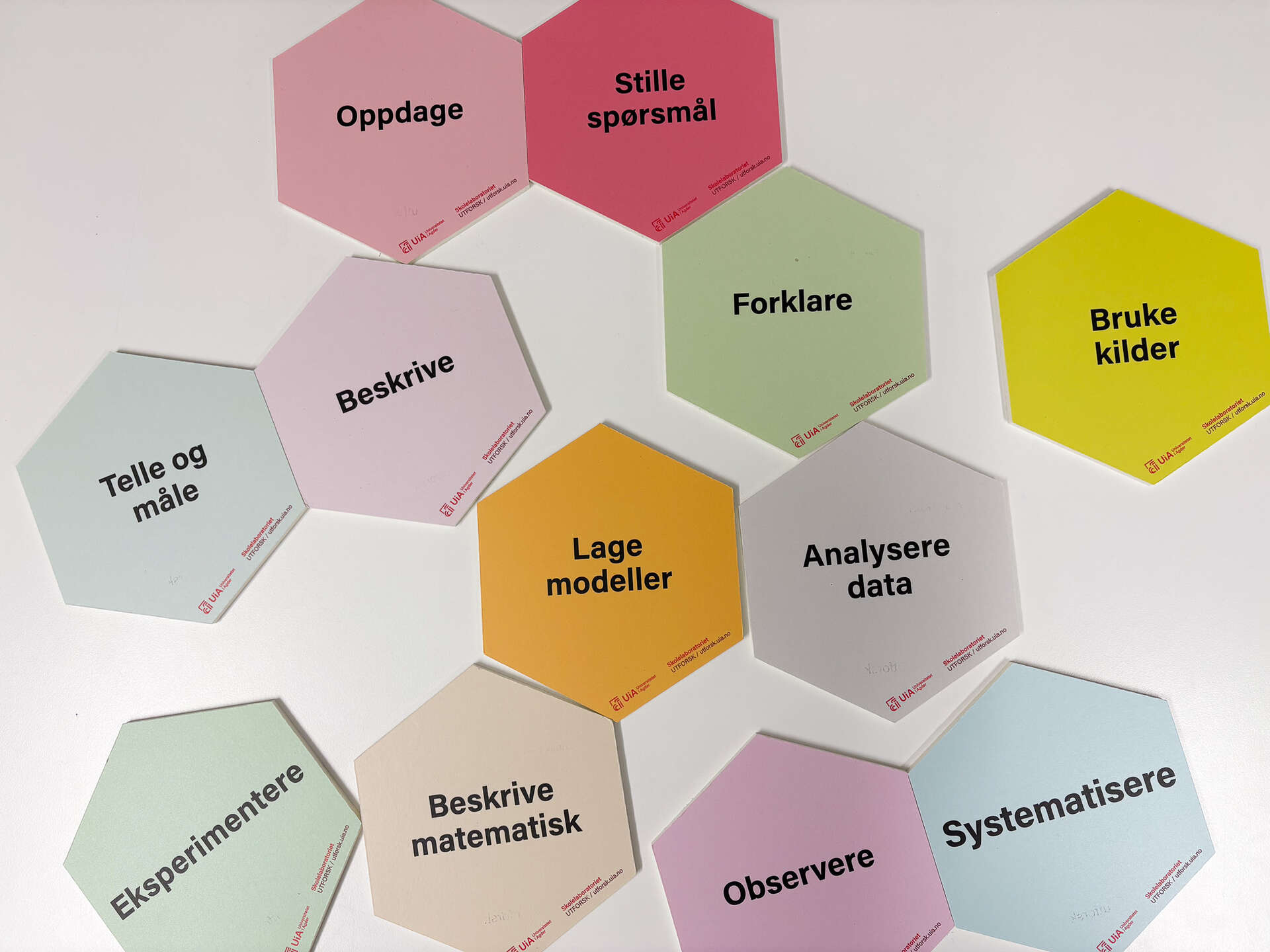
"Natural science teaching methods should be a recurring feature in all aspects of science education in schools, but teachers feel that this is defined rather vaguely in the curriculum. We wanted to make the concept more tangible, both for teachers and pupils", says Anne Lien at UiA.
The tool, called UTFORSK, consists of twelve skills visualised as colourful hexagonal tiles. These include observing, describing, systematising and experimenting. The tiles can be arranged in various ways, allowing teachers and pupils to discuss for themselves which skills an investigation requires. They can be used both in the planning and carrying out of an investigation, and in the subsequent reflection.
"We chose the verbs deliberately. Science is also something we do; it’s not just about reading facts,” says Lien.
Lien explains that when we use artificial intelligence (AI) tools in teaching, AI often functions as a black box.
"With AI, pupils enter a question and quickly receive an answer, without the path to knowledge becoming visible."
FACTS about UTFORSK
- Developed by the research group in science education at UiA and the School Science Laboratory
- Consists of 12 skills, visualised as hexagonal tiles. Developed over three rounds with teachers, school leaders and other stakeholders.
- 12 out of 17 teachers in a pilot test would use the tool in their own teaching.
- 100 physical tile sets have been purchased and can be ordered by schools, together with a teacher’s guide.
Check out the website for more information about the tool (in Norwegian)
There you will find a guide to the tool and suggested exercises demonstrating how the ‘Utforsk’ tool can be used. The hexagonal tiles that make up the tool can be downloaded as an A3 poster. In addition, you can download a file containing guiding questions to support teachers in using the tiles.
The new tool is designed to help ‘open up’ this box by encouraging discussion and active engagement with the process itself, not just the result.
"A large part of the point is to open up the black box. With this tool, pupils learn how to arrive at answers by conducting their own investigations", she says.
Tested in three rounds
The development has been carried out through design-based research. The research team led by Anne Lien has undergone repeated rounds of testing and refinement, in close collaboration with science teachers who will be using the tool.
An early version of the tool was trialled at a teachers’ conference, attended by 22 teachers. Of the 17 who completed a post-event evaluation, 12 said they would use the tool in their own teaching.
"Primary school teachers in particular were positive. This may suggest that, for the time being, the tool is easiest to implement at lower year groups", says Lien.
A gap between theory and practice
In the final round, the tool was presented to a wider group, including headteachers, in collaboration with UiA’s innovation service.
Here, the researchers discovered that many teachers are accustomed to thinking of science as the communication of facts, rather than as training in investigative processes.
"This creates a gap between what the curriculum sets out to achieve and what actually happens in the classroom", says Lien.
Three principles for making it work
The researchers have formulated three principles to ensure that a tool designed to facilitate exploration can work in practice:
It must be flexible and encourage dialogueIt must stimulate active learningIt must provide teachers with real support in their teaching
“The project demonstrates just how much one gains from developing teaching resources together with those who will use them. The aim is for pupils to acquire skills they can use even outside science lessons,” says Lien.
Source