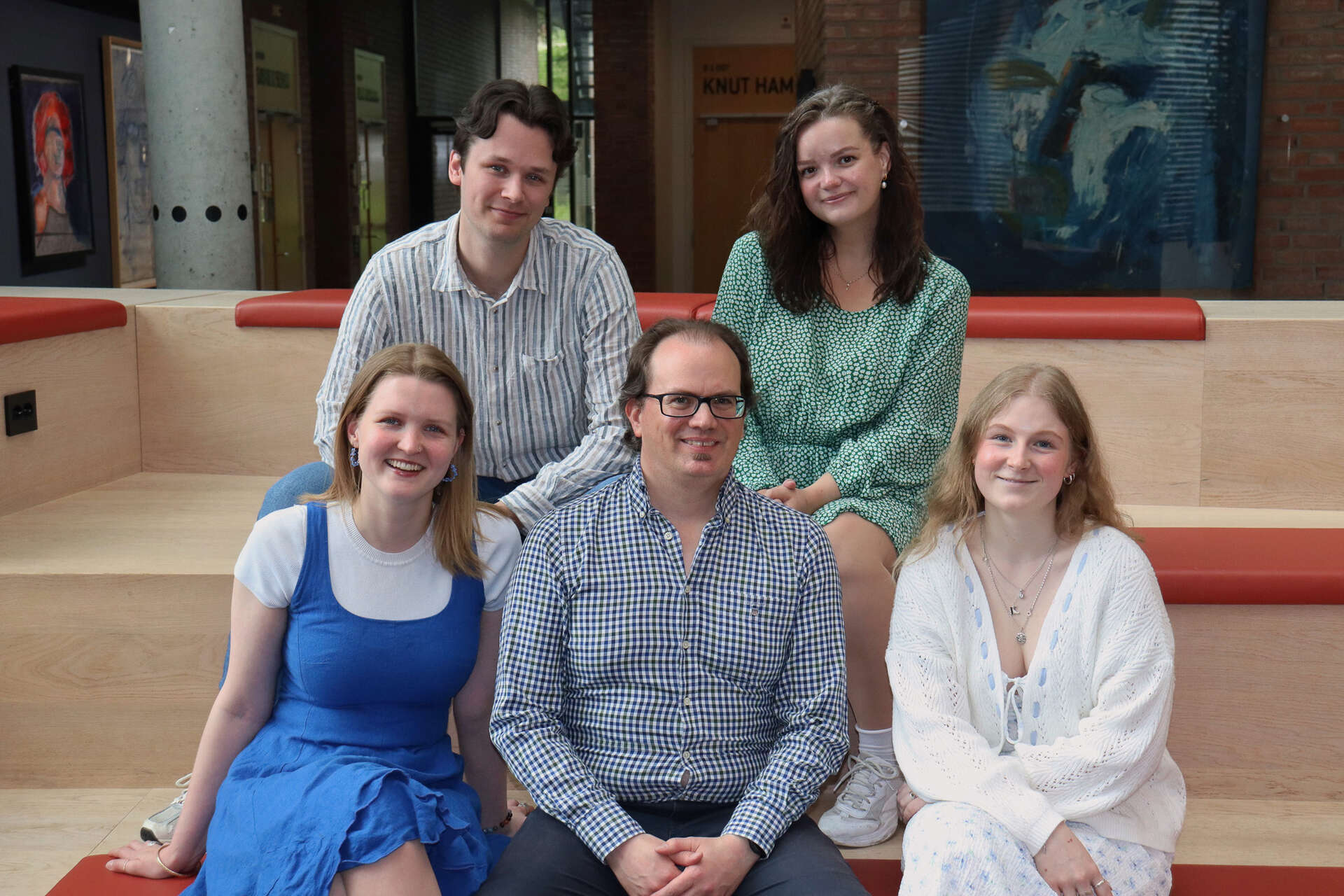
"What started as an idea from Kristiansand is now policy for 20 million European students. It’s a real honour to have been part of that process", says Magnus Ellefsen Moen, leader of the Agder Student Organisation (STA).
Student data in American hands

The issue is that universities and university colleges today rely on digital tools and digital infrastructure that are largely owned by US companies. At UiA, platforms such as Microsoft, Meta and Google are used for, amongst other things, email, file storage and advertising.
For students, this means that sensitive information and academic work may be stored on servers controlled by entities outside Norwegian and European jurisdiction.
“We believe it is important to safeguard students’ privacy, as well as academic freedom,” says Moen.
STA believes that the issue of digital sovereignty is not an abstract matter of technology policy, but something that directly affects students: Who actually has access to the work you submit in your exams?
From the student parliament to Europe
STA took the initiative after following the European debate on digital sovereignty. The organisation drafted a resolution which was submitted to the national conference of the Norwegian Student Organisation (NSO). There, it was passed with almost no discussion.
“It’s brilliant that this is happening in that forum,” says Moen.
The Student Organisation in Agder (STA)
STA works to promote students’ academic, social and financial interests. This means, for example, that teaching should be of a high standard. It also means that no student at UiA should feel excluded or bullied, and that STA works to ensure it is possible to live as a full-time student on funding from the Norwegian State Educational Loan Fund. In addition, STA safeguards student democracy at UiA. The STA board is elected by the Student Parliament and is responsible for implementing the policies adopted by the Parliament.
The resolution was forwarded to the Nordic-Baltic student cooperation body, and subsequently to the European Students’ Union (ESU). In early June, they adopted the resolution as part of their programme on digitalisation and artificial intelligence.
An American law with European implications
The background to STA’s involvement is the US CLOUD Act. The Act gives US authorities the right to require US companies to hand over data, regardless of where in the world that data is located.
This was confirmed in June 2025 when Microsoft’s general counsel in France appeared before the French Senate. Under oath, he acknowledged that Microsoft cannot guarantee that data from French authorities is protected against US demands.
Tørres Andreas Båshus, head of education policy at STA, followed the hearing closely.
“They stated quite clearly that the CLOUD Act forces Microsoft to hand over data on documents stored by a French citizen in a data centre in France. That is the legal reality we live in,” he says.

Call for political will from UiA
STA urges UiA and other educational institutions to explore open alternatives and use their voice in national and European forums. France is already in the process of replacing software for two million public sector employees.
"There is little UiA can achieve on its own. But UiA must dare to speak out on this issue,” says Moen.
STA is backed by 14,000 students at UiA and 200,000 through the Norwegian Student Organisation (NSO).
“It’s a matter of being proactive. If something serious actually happens, then it will be too late,” says Båshus.