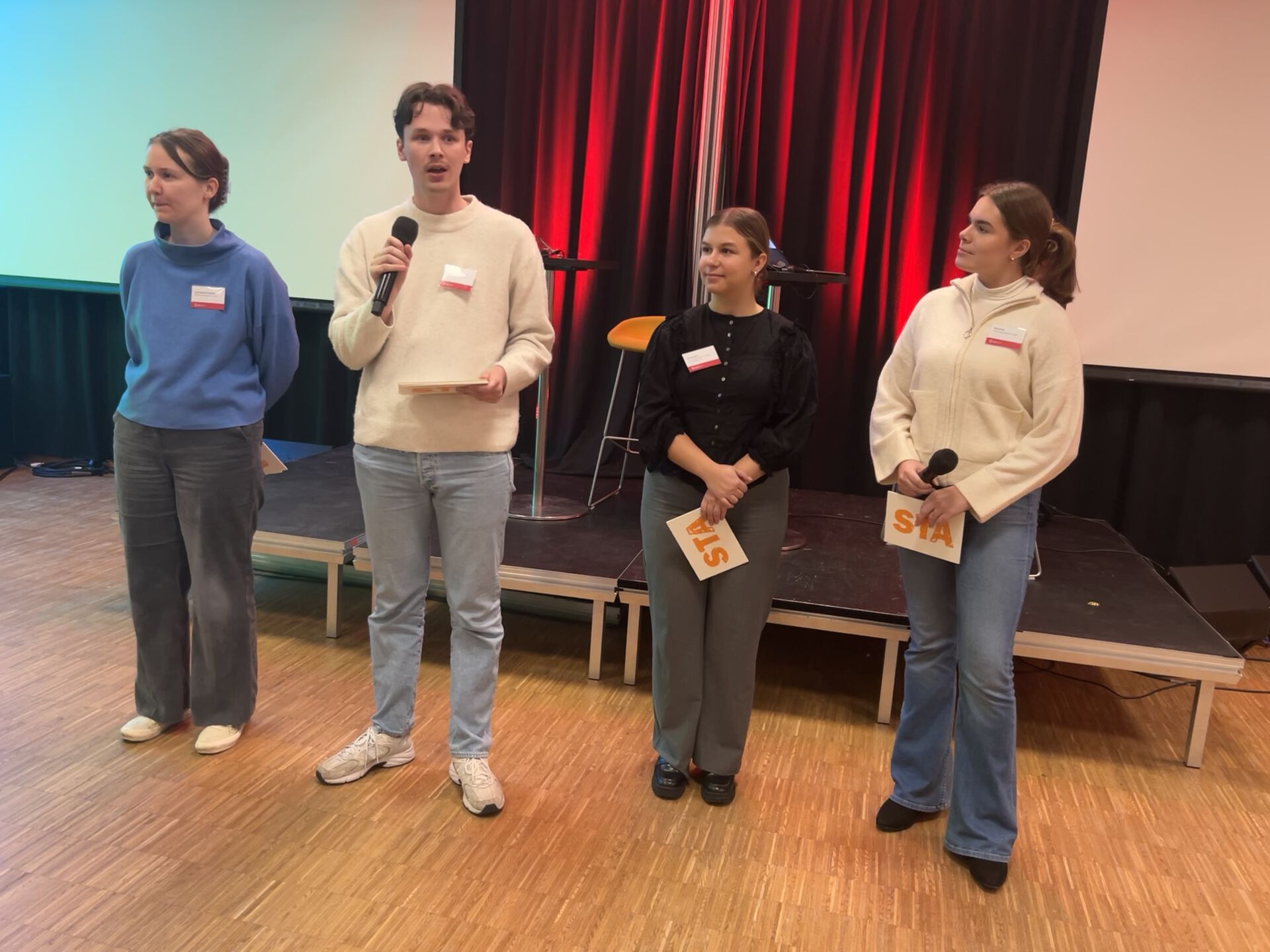
"Now's the perfect time for us to talk about the students' university. We have important views about what UiA offers, and you have important views about us as students, which can help us become resilient individuals," says Magnus Ellefsen Moen, president of the Student Organisation of Agder (STA).
Together with three other STA board members, he stands before 60 UiA leaders, providing input on how the university can achieve its goal of becoming "the students' university." Also in the audience are several other students from the Student Parliament.
This is UiA's strategy for 2025-2028 (pdf)
Resource in research
Oda Aamelfot Krohn, whose area of focus in STA is education and research policies, urged UiA leaders to involve students more in research projects. Students need to be aware of ongoing research and gain the confidence to get involved.
"It's essential that we feel included, even at the bachelor's level. This will aid our personal and academic development. We might fear not being competent enough, but there must be room for us. Researchers must view us as a resource," she says.
"Listen to our input!"
Eva Scharpf, who focuses on learning environment policies in STA, uses the term "academically social" (fagsosial). The study experience involves both the subjects to be learned and the environment in which learning takes place.
"Listen to our input! We're on campus all the time and social activities matter," she says, referring to things like heating, cafeteria opening hours and the academic societies’ activities.
Personal development is also important
The deputy president of STA, Lisa Kjosnes Fredsvik, talked about life after university and the skills needed for a smooth transition into the workforce.
She stressed the need to focus on personal development and the more generic skills required in the job market.
"What about the ability to collaborate, understanding one's role and that of others? We students have little exposure to the skills needed to function effectively in the workplace," says Kjosnes Fredsvik, questioning who is responsible for equipping students with them.
Setting boundaries for accommodations
After the introductions, the students engaged in group discussions with UiA leaders, addressing various questions:
- What should students expect from UiA in terms of education, the learning environment and campus design, and how can they take responsibility?
- How can UiA actively facilitate student involvement and democracy?
- What is needed to increase student participation in research and development work?
- How should students learn to express their competencies, and how should they establish connections with the professional world?
During the summary following this session, STA President Magnus Ellefsen Moen emphasised the importance of holding students accountable and setting limits for special accommodations being made.
"We must express our needs! We must focus on ourselves and make our presence felt in the spaces we occupy. The extent to which students want to engage varies greatly. We need to discuss what we expect from our fellow students as peers," he says.
"I believe it is possible to truly become the students' university. We must ensure we avoid becoming the parents' university," says the STA president, alluding to recent media coverage on parental interference.
See also: UiA aims to be the students' university