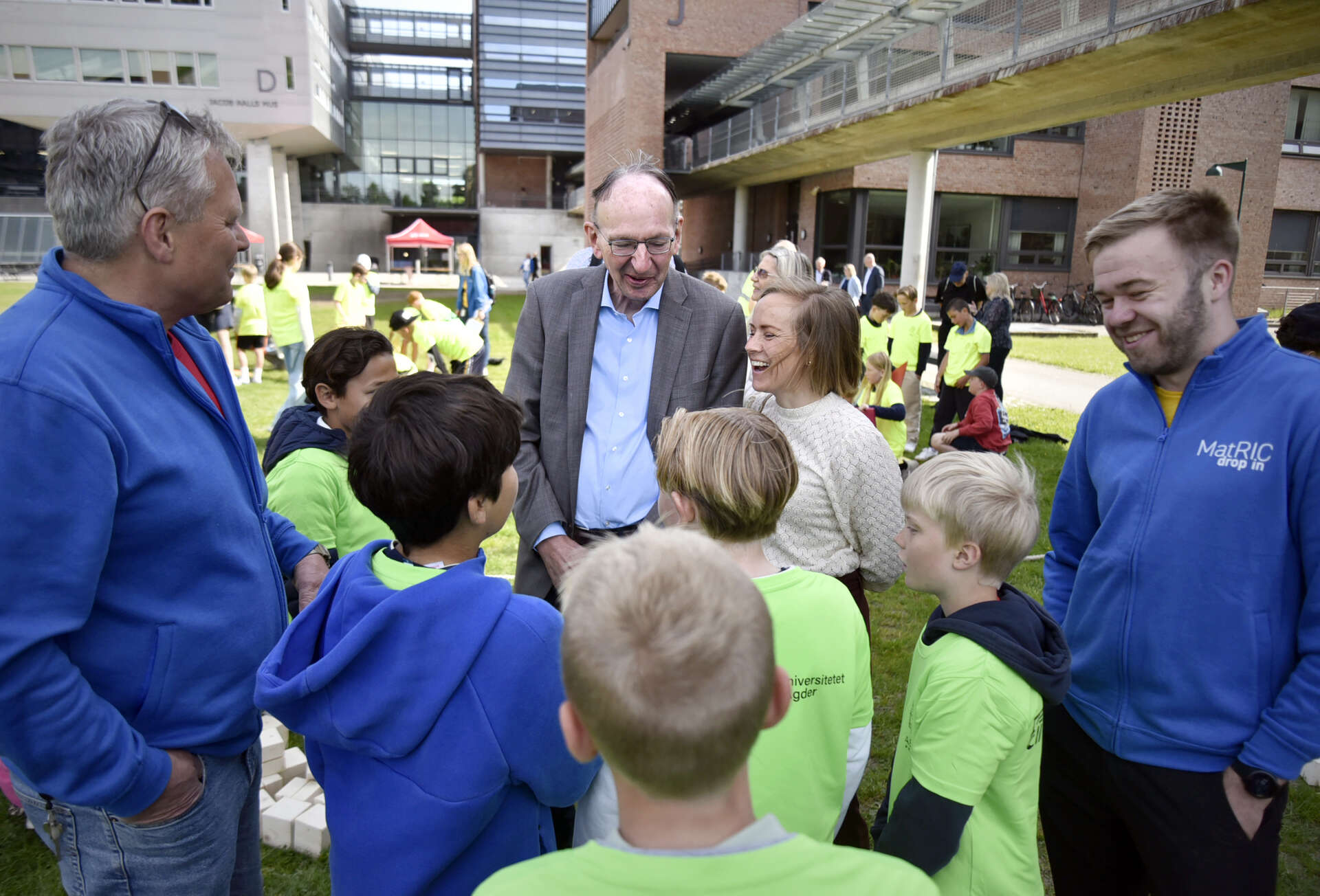
Fresh from the Abel Prize ceremony in Oslo earlier in the week, the German laureate Gerd Faltings spent the day at UiA, where the highlight was meeting 400 fifth‑year pupils from Agder. They took part in activities in physical mathematics – tasks solved as much through movement and play as through reasoning.
The laureate from the Max Planck Institute in Germany did not say much as he walked among the groups, but his smile grew wider with every child he greeted. Not all of them knew he had just been named the world’s leading mathematician, but all welcomed him like a superstar.
“It is important to spark enthusiasm for mathematics. Ten‑year‑olds think maths is fun, and meeting a genuine celebrity in the field makes it even more exciting,” says Martin Nordskog, project leader for Abeldagen at UiA. And adds:
“If today makes even a few of them enjoy mathematics a little more than when they arrived this morning, then we’ve achieved something.”
Solving problems with upper‑secondary students
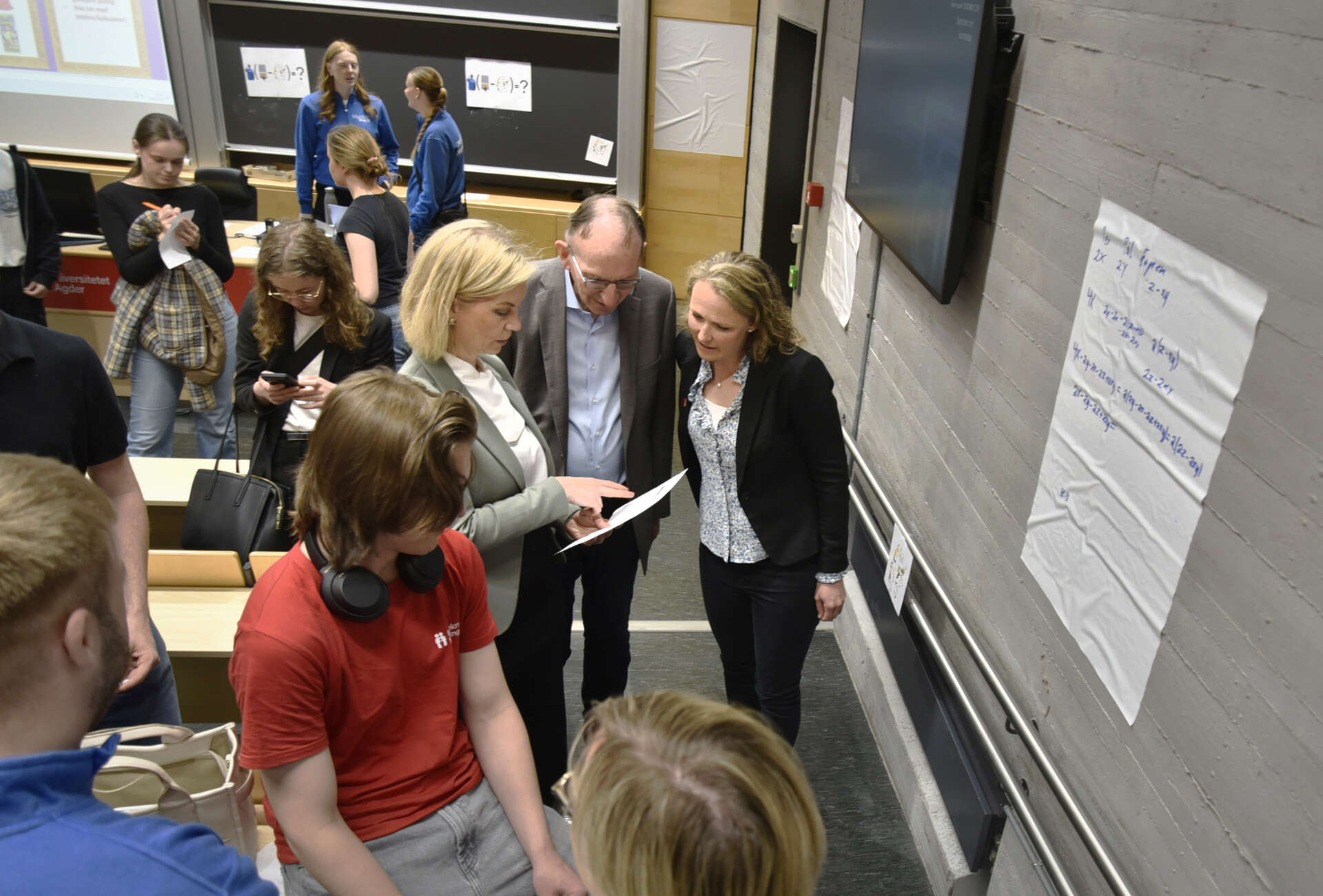
Faltings also met 200 upper‑secondary students from Agder who study mathematics as a programme subject. They competed to become the region’s best maths group, and Faltings joined them in solving problems – together with Minister for Higher Education and Research Sigrun Aasland, who also visited UiA that day.
Arithmetic geometry and number theory
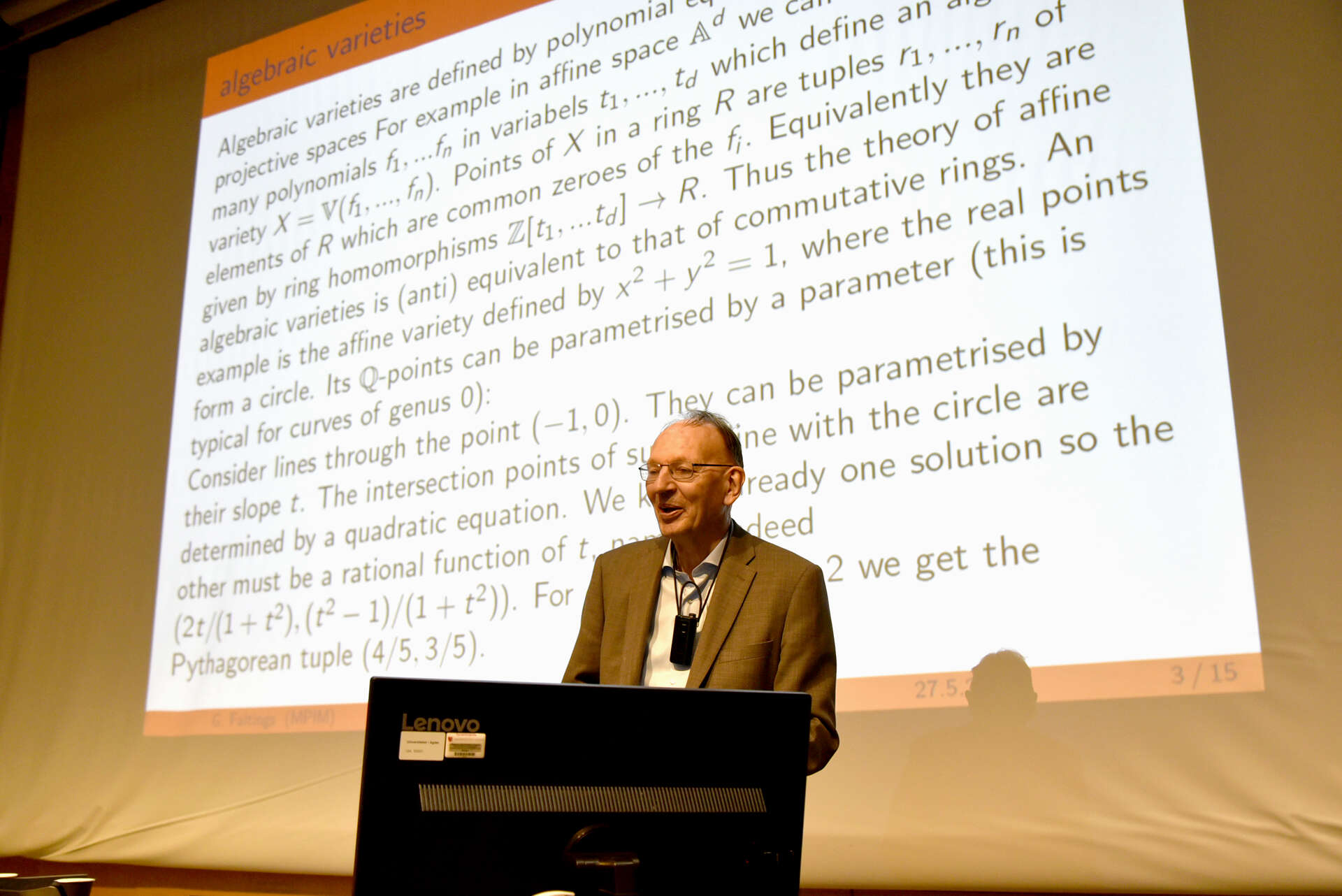
In his Abel Lecture later in the afternoon, Faltings spoke about his path into mathematics – from his student days in Germany, through many years in the United States, to his current work at the Max Planck Institute. He described his early fascination with the subject, and how it is still mathematics’ ability to determine what is true and what is false that drives him.
Faltings works in arithmetic geometry and number theory. He is especially known for proving Mordell’s conjecture, which states that a certain type of curve can have only a finite number of points where both x and y are integers – a problem that had remained unsolved since 1922. This achievement first made him well‑known among specialists, and later internationally.
Cybersecurity, AI, and quantum computing
Although few of us will ever use his theories directly, much of today’s digital world rests on insights developed by Faltings and others. When you log into online banking, secret keys are exchanged using large prime numbers and mathematical curves – structures rooted in his field. Without such breakthroughs, passwords would be far easier to crack.
The same applies to end‑to‑end encryption in messaging apps such as WhatsApp, used by more than two billion people. Fundamental methods in artificial intelligence and future quantum technologies also rely on mathematical tools that Faltings has helped develop.
A visit to Abel’s last home
After his visit to UiA, the Abel Prize laureate travelled on to a formal dinner at Froland farm, where Norway’s most famous mathematician, Nils Henrik Abel, spent the final years of his life. The Abel Prize is named in his honour.