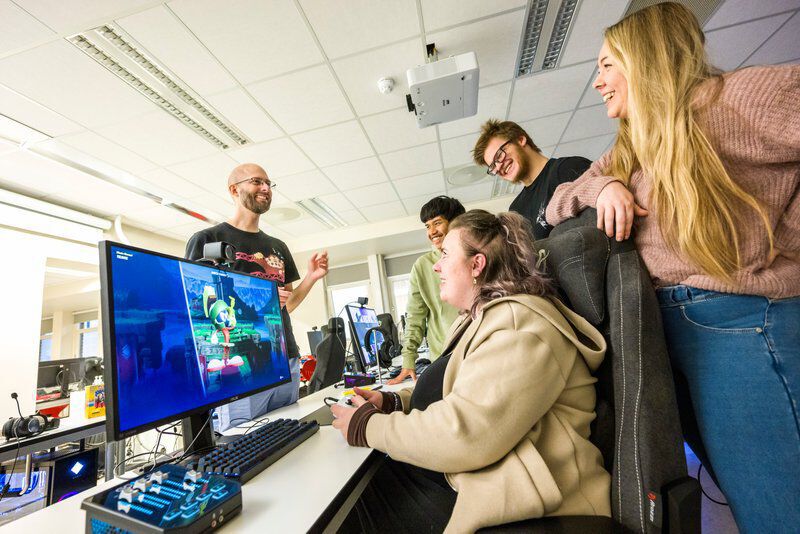
"Esports is no longer just about competition. It is an important tool for understanding and developing the digital society," says Associate Professor Tobias Michael Scholz at the University of Agder (UiA).

Esports is organized, regulated competition between video game players. It is one of the world's fastest growing sectors in sport and entertainment and has quickly become a professional industry. But Scholz believes there is more to it than that.
"Esports touches many aspects of modern life. It is part of media, education, technology, health, culture and community. Thus, esports can serve as a bridge between different sectors in society," says the researcher.
In May 2025, Scholz is involved in organizing two esports gatherings.
The gatherings are the Norwegian Esports Summit 2025 and the Academic Esports Seminar 2025. They will bring together national players and international experts to explore the potential of esports to shape future education, digital societies and working environments.
Also read:
- What is esports
- UiA expands international esports cooperation
- UiA researcher co-author of new handbook on esports
- How gaming can help you in your career
Will create a national strategy
The Norwegian Esports Summit will take place on 19-20 May. The goal is to establish Norway's first coordinated strategy for esports.
"Participants will develop plans for how to include esports in youth work, education, local business development and public health initiatives. What makes this gathering special is the commitment to co-creation – participants will not be passive listeners but active contributors," says Scholz.
Participants include esports athletes, researchers from UiA and other institutions, and political actors involved in national digital development. Discussions will cover everything from inclusion in education and infrastructure to innovation across sectors. And not least what Scholz calls 'digital well-being' – after all, it's about video games.
International cooperation
During the following days, 21-23 May, the Academic Esports Seminar 2025 will advance the discussion around esports to an international level. Researchers, educators and participants from around the world will gather to exchange knowledge and develop future-oriented solutions.
"The seminar will show that esports is a serious field of research with academic weight," says Scholz.
The programme features lectures by leading experts in esports and digital culture.
Scholz highlights some key events:
- Tom Brock from Manchester Metropolitan University will provide a sociological perspective on how competitive gaming environments shape identity and social capital
- Ben Bays from the University of Texas will explore new boundaries in media and storytelling through esports broadcasts
- Brian McCauley from Jönköping University will discuss the spatial and cultural significance of esports
- Kim Tvedt, Director of Strategy at HEROIC, will talk about the development of the esports market and the future of the industry in Norway
- Anne Tjønndal from Nord University will deliver the keynote address, 'Virtual Roads, Real Barriers: Social Inclusion/Exclusion at the 2024 Cycling Esports World Championships', highlighting how esports can both promote and hinder social inclusion
Leading role for Norway
Scholz and his colleagues at UiA are planning a research centre for academic esports and gaming technology. This centre will build an international network of researchers, educators and experts who can together understand and shape the digital development in society. The plan is for it to open in 2027.
"Norway is investing in esports, not just as an industry, but as a platform for innovation across disciplines. With this new centre, Norway can take a leading role internationally in esports policy, research and education," says Scholz.