
Researchers at the University of Agder (UiA) and Uppsala University are examining hundreds of snakes from museum collections. They are looking for traces of a deadly fungal disease.
The goal is to understand more about the fungus Ophidiomyces ophidiicola, as it is called in Latin. Where does it come from, what kind of snakes does it attack and how long has it been around?
"We are mapping the disease to understand more about how it affects snakes and how it spreads," says zoologist Beate Strøm Johansen at the Natural History Museum and Botanical Garden, UiA.

By studying snake collections in museums, researchers can find out where the fungus has spread in the past. They can also find out how far back in time the fungus has affected snakes.
Fungus found in Europe
The fungus was first discovered in the US in 2006. It came as a shock to European researchers when it was found in the UK in 2017.
The fungus first infects skin and scales with brown and dry spots. It gradually attacks the lungs, eyes and other internal organs. Snakes can have difficulty breathing and become blind. In the worst case, entire populations of snakes could be wiped out.
"We need to understand the extent of this disease. The fungus could have major consequences for snake species all over the world," says Johansen.
Will find answers this year

Malene Ø. Nygård is a conservator and molecular biologist at the UiA Natural History Museum. She has isolated DNA from over 300 snakes and shed skins, collected by Johansen and her students. Among the snakes are all the species found in Norway: smooth snakes, grass snakes and vipers.
"We are excited about the results, both from the samples of the living snakes and the research we have now started on dead snakes in the collections at various museums. This could give us important knowledge both about the history of the disease and what we can possibly do to protect snakes in the future," says Nygård.
Old snakes give new answers
The project is a collaboration between the University of Agder, Uppsala University (UU) and the Swedish University of Agricultural Sciences (SLU).
The researchers have so far examined around 120 snakes from the Museum of Evolution in Uppsala and the Natural History Museum in Oslo. This autumn, they plan to study snakes at the Swedish Museum of Natural History in Stockholm and at collections in Trondheim.
Snakes in alcohol
The snakes are in jars and preserved in alcohol or formalin. The lids of the jars are sealed.
"We first look at the snakes through the glass. We look for brown spots and signs of infection. If we get the museum’s permission, we open the seals and collect tissue samples with a scalpel and cotton swabs. We analyze the samples under a microscope and in the DNA lab," Johansen says.
The snakes they are examining can be several hundred years old.
"By mapping old snakes, we can find out which areas and snake species might be particularly vulnerable to the fungus," says Johansen.
Cannot infect humans
The fungus cannot infect humans directly. However, humans can help spread it to new areas. This can happen through soil and equipment or via escaped pet snakes that are infected with the fungus.
The origin of the fungus is still unclear. It likely resides naturally in the upper soil layer. But no one knows yet why it targets snakes.
"There are two other species of fungus that resemble the deadly one. The other two are not as dangerous but complicate the identification of the type we are looking for. It is important to accurately identify this particular deadly fungus," Johansen says.
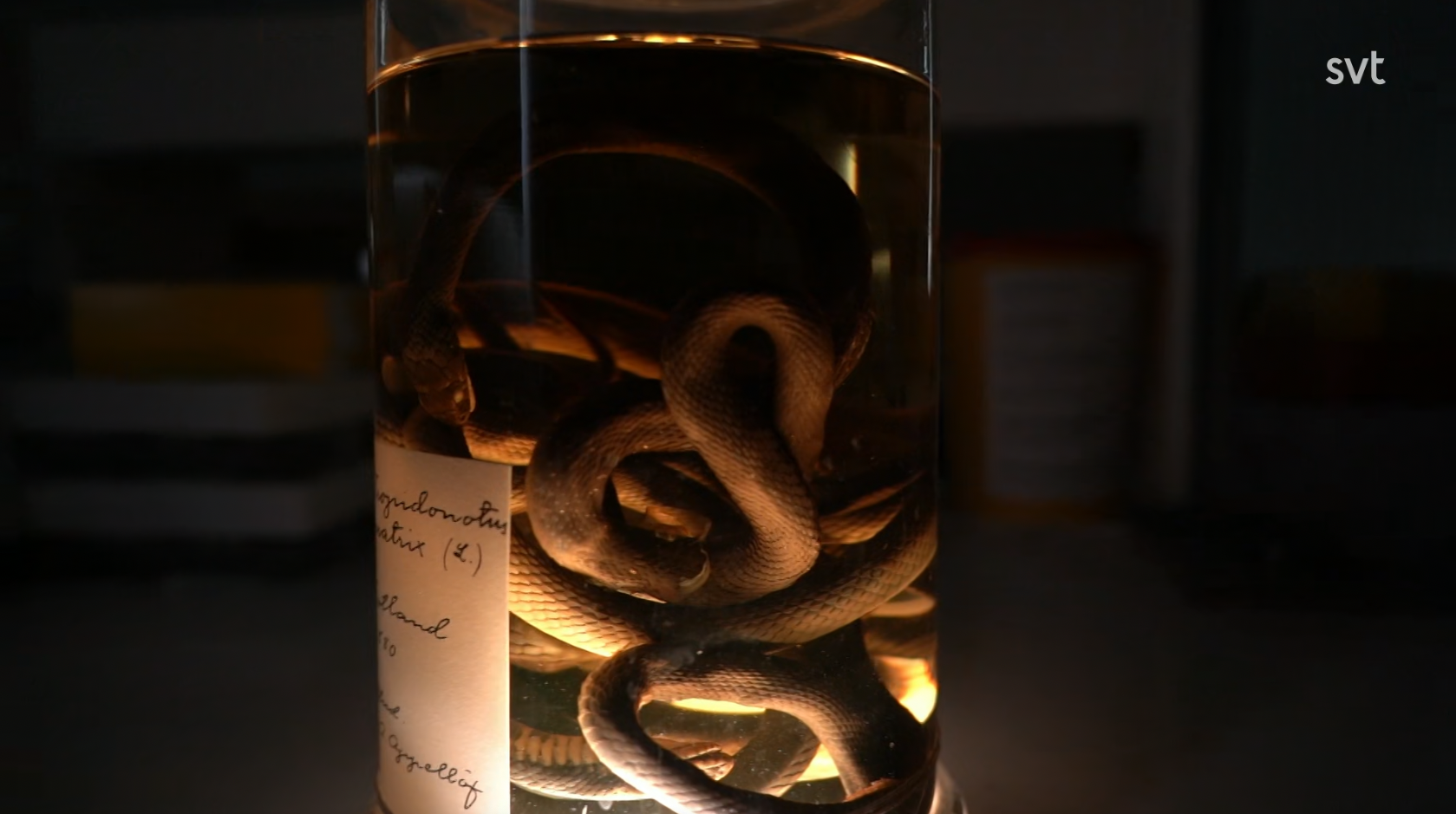
The Swedish public broadcaster SVT has produced this television report about the hunt for the deadly snake fungus (in Swedish).