
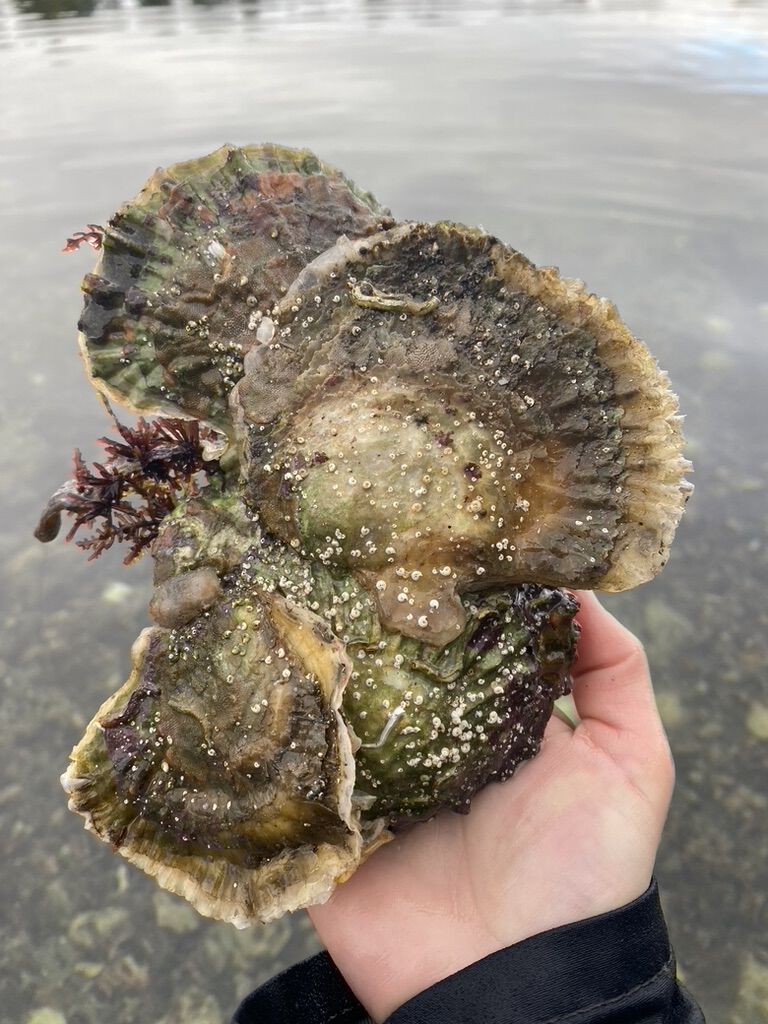
"Flat oysters form reefs that serve as vital habitats for other species. In Europe, these reefs have nearly vanished. We still have intact populations in Agder and Rogaland, so we must protect them better," says UiA doctoral candidate Molly Reamon.
Alongside Johanna Marcussen and Professor Ane Timenes Laugen from UiA, Reamon has submitted their consultative response to the Directorate of Fisheries' proposal to protect flat oysters in Norway. The researchers stress that Norway and Sweden are home to Europe's last healthy populations, so Norway has a unique international responsibility to conserve them.
Survey shows unique oyster findings
UiA researchers conducted the first major survey of flat oysters in Norway from 2020 to 2022, looking at 373 locations. Flat oysters were found at just one in three sites, and only one per cent of locations had dense populations.
Reamon explains that these findings show that dense populations are rare and vulnerable.

"Although flat oysters were reclassified from 'near threatened' to 'least concern' on the Norwegian red list in 2021, strong protection is needed. Particularly because the classification is based on weak data. We believe the precautionary principle should apply," she says.
Researchers recommend temporary harvesting ban
UiA researchers suggest a national or regional harvesting ban for three to ten years. This should be coupled with research monitoring flat oyster populations. They emphasise the potential risk of unregulated recreational fishing. Flat oysters are also being harvested for restoration projects in Europe.
Johanna Marcussen researches recreational fishing. She explains that flat oysters are often mistakenly collected when people clear Pacific oysters.
"This shows that we need stricter rules and more knowledge," she says.
Protection must be strengthened – not weakened

The researchers explain that a fishing ban in the Oslofjord is an essential first step in protecting vulnerable ecosystems, such as flat oyster beds. However, they find the Directorate of Fisheries' proposal for Agder and Rogaland too weak.
"A partial ban in two small areas isn't enough. It doesn't ensure connectivity between populations in Agder and Rogaland. The researchers also warn that the proposal might actually weaken current protections in Sørlandsleia," says Ane Timenes Laugen, professor of marine ecology at UiA.

"As stewards of Europe's last healthy populations, increasing harvesting now would be a step in the wrong direction," she adds.
Need for better cooperation
The researchers call for closer cooperation between the Directorate of Fisheries, the Norwegian Environment Agency and other authorities to ensure holistic management of coastal ecosystems. Under the OSPAR agreement, Norway has pledged to protect flat oyster beds.
"Strengthened protection is crucial for keeping flat oysters as a key species in Norwegian coastal areas and for safeguarding Europe's last disease-free populations for the future," says Timenes Laugen.