Registration Deadline
The deadline for registering your research publications is 31 January.
What is NVA?
Recommend new journals to the Kanalregister
Submit recommendations for journals and publishers to the Kanalregister. The annual deadline is 30 November.
NVA brings together the functionalities of both Cristin and AURA (Brage), offering a unified platform for registering, archiving, and sharing research results. NVA is developed and maintained by Sikt, the Norwegian Agency for Shared Services in Education and Research, and is part of the national infrastructure for Open Science.
All researchers at UiA are required to register their academic publications and other research activities in NVA each year.
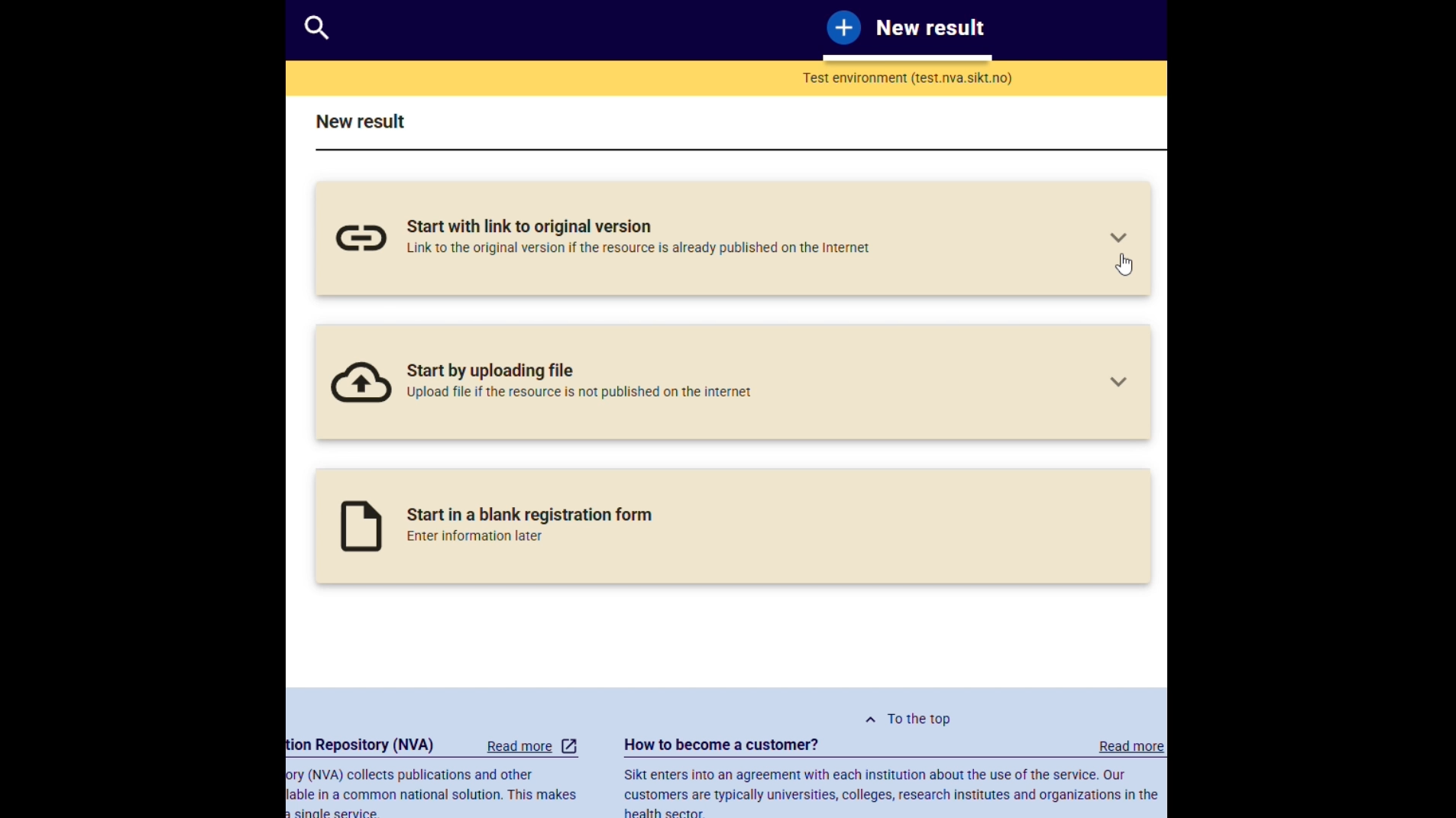
How to register a research result in NVA
Each researcher at UiA is responsible for registering their academic publications and research results in NVA. For academic publications, it is required that a peer-reviewed, full-text version is uploaded in NVA. The library evaluates all registrations that contain full-text documents and makes them available Open Access in line with UiA’s Open Access policy and national reporting requirements.
Instructions and guidance at UiA:
Further guidance from Sikt:
- How to register results in NVA (Sikt)
- How to register projects in NVA (Sikt)
- Available reporting categories in NVA (Sikt)
- How to connect your ORCID to your NVA profile (Sikt)
Instruction video:
Research results that contribute to publication points
In Norway, each academic publication is allocated publication points in accordance to the national reporting system. The number of publication points awarded is dependent on the following factors:
Categories in NVA that contribute to publication points
- Reporting category: Not all categories in NVA give publication points. The following that can give publication points are:
- Academic articles (journal publication)
- Academic review articles (journal publication)
- Academic monographs (book publication)
- Academic commentary (book publication)
- Academic book chapter (part of a book or report)
- Norwegian Publication Levels: The level of the journal or publisher within the Norwegian Register for Scientific Journals, Series and Publishers.
- Level 1: gives publication points
- Level 2: gives publication points
- Level X: gives publication points (can be regarded as level 1)
- Level 0: does not give publication points
- The reporting categories are assigned different amounts of publication points:
- Academic monograph:
- Level 1: 5 points
- Level 2: 8 points
- Academic article:
- Level 1: 1 point
- Level 2: 3 points
- Academic chapter:
- Level 1: 0.7 points
- Level 2: 1 point
- Academic monograph:
- Publications with international contributors receive a higher number of publication points (1.3 coefficient).
NVA User Support
When users register a research result, they can contact an NVA administrator at the UiA library directly within the NVA system by clicking on the button marked "get help from curator." In addition, each faculty at UiA has an NVA Superuser who can provide help and guidance on using NVA.
| Faculty of Social Sciences | Cecilie Rygh Mawdsley | cecilie.mawdsley@uia.no |
| Faculty of Fine Arts | Astrid Marie Lunde Gilje | astrid.m.gilje@uia.no |
| Faculty of Health and Sport Sciences | Tone Soldal | tone.soldal@uia.no |
| Faculty of Humanities and Education | Inger Lin Nystad Baade | inger.l.baade@uia.no |
| Faculty of Engineering and Science | Kristine Evensen Reinfjord | kristine.reinfjord@uia.no |
| School of Business and Law | Gunvor Guttormsen | gunvor.guttormsen@uia.no |
Open Access: Copyright & Licences
Different Versions of a Publication
When uploading a full-text document to NVA, it is important to know which version is permitted to be shared.
- Published Version: The final, formatted version released by the publisher.
- Accepted Manuscript: The version after peer review but before publisher formatting and typesetting.
Different Types of Open Access Models
There are several types of Open Access publishing, each with different implications for what can be archived:
- Green Open Access: Authors are permitted to deposit the accepted manuscript in a research repository like NVA. This may involve an embargo period.
- Gold Open Access: The published version is freely available immediately, often after payment of an Article Processing Charge (APC) by the author or institution.
- Diamond Open Access: The journal provides free access to published articles without charging APCs to authors or readers.
- Hybrid Open Access: A subscription-based journal where individual articles can be made open access if an additional APC is paid by the author.
Creative Commons Licences (CC)
Creative Commons licences make it possible to determine how others may use the research result. Selectable CC licence types in NVA include:
- CC BY: Others can use and adapt the work, even commercially, as long as they credit you.
- CC BY-SA: Like CC BY, but adaptations must be shared under the same licence.
- CC BY-NC: Others can use and adapt the work for non-commercial purposes only, with attribution.
- CC BY-ND: Others can share the work unchanged, for any purpose, with attribution, but no modifications are allowed.
- CC BY-NC-SA: Others can use and adapt the work for non-commercial purposes, but adaptations must be shared under the same licence.
- CC BY-NC-ND: Others can share the work for non-commercial purposes, with attribution, but cannot modify it or create derivatives.
Right Retention Policy
UiA supports researchers in retaining the rights to share their work openly. Read more about the UiA’s Rights Retention Policy.
Further Training
If you or your research group would like further training, please contact the UiA Library at researchsupport@uia.no.
Dataverse
Publishing research data enables others to access and reuse it. There are many services available for this purpose, the University Library offers access to DataverseNO. See the Dataverse.NO guide for more information about the steps involved in this process.