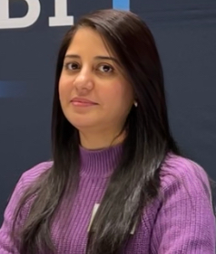
Maryam Hina will defend her PhD dissertation “Blockchain for sustainability: A multilevel perspective connecting consumers and organisations”, as part of the PhD programme at the School of Business and Law.
She has completed her doctorate through a cotutelle agreement, and therefore a joint defence will be held digitally.
A cotutelle means “joint supervision.” The arrangement originates from France and is an agreement on joint supervision at the doctoral level. The cotutelle agreement is individual, and is entered into between two collaborating institutions, the PhD candidate, and the candidate’s supervisors. After completing the PhD programme, the candidate receives a diploma from each of the institutions, where the collaboration is stated.
The defence follows the format of Lappeenranta-Lahti University of Technology LUT. The procedures for this can be found here. A trial lecture will be arranged digitally by UiA, since this is not a requirement at LUT.
Trial lecture starts at 09:15 Norwegian time.
Defence starts at 11:15 Norwegian time.
The trial lecture topic is “The role of digital transformation in sustainable supply chain management".
Assessment committee:
- Associate Professor Muhammad Mustafa Kamal, University of Exeter Business School, UK (1.opponent)
- Associate Professor Hongxiu Li, Tampere University, Finland (2.opponent)
- Docent Arto Lanamäki, University of Oulo, Finland (not opponent, part of written evaluation)
- Professor Kimmo Alajoutsijärvi (komiteadministrator, UiA)
Supervisors in the doctoral work:
- Supervisor LUT: Professor Najmul Islam
- Supervisor UiA: Professor Amandeep Dhir
Summary of thesis
Consumers' interest in sustainable consumption is growing, yet adoption remains low due to the uncertainties surrounding sustainable products, which has become a prevailing concern given the untrustworthy businesses’ sustainable practices.
While growing academic scholarships have proposed digital solutions to streamline business sustainable practices, such as sustainable supply chains, a significant knowledge gap exists in furnishing the potential impact of blockchain on consumers' sustainable behavior and aligning organizational efforts for a sustainable future. Consequently, it confines the conceptual understanding and practical implications for designing digital solutions that could support sustainable decision-making. This dissertation investigates the impact of blockchain on sustainability from both consumers’ and organisations’ perspectives. Specifically, it aims to examine how and in what way blockchain can affect consumers’ sustainable decision-making and may reduce the uncertainties related to sustainability outcomes across organisational practices. This research, from a consumer’s perspective, uses the theoretically grounded research models (i.e. based on the consumption value, affordance and signalling theories) to rationalise the impact of blockchain on consumers’ sustainable consumption behaviour.
From an organisational standpoint, it builds on the theoretical concepts of IT artefact characteristics and digital supply chain integration to explore the potential role of blockchain to mitigating uncertainties surrounding sustainable sellers and products. This dissertation has adopted a mixed-method approach, combining focus groups, scenario-based surveys, and experiments. Altogether, the research findings offer novel insights into the varying effects of blockchain revealing the positive impact of blockchain affordances (i.e.transparency, traceability, and immutability) on the consumption values that drive sustainable purchase intention. However, when consumers have informationseeking tendencies, blockchain transparency has a negative impact on consumers’ satisfaction with sustainable products. At the organisational level, digital supply chain integration (operational, information, and relational) positively affects supply chain collaboration and enhances sustainable product authenticity.
Nevertheless, if organisations use blockchain-based platforms, the interaction effect of transparency levels on the association between operational integration and supply chain collaboration declines. Similarly, while IT artefact characteristics of digital supply chain platform (i.e. traceability and immutability) positively affect
How to watch the defense online
The public defence is open to everyone and can be followed digitally via Zoom here.
Questions?

- gunvor.guttormsen@uia.no
- Phone
- +47 38 14 16 48