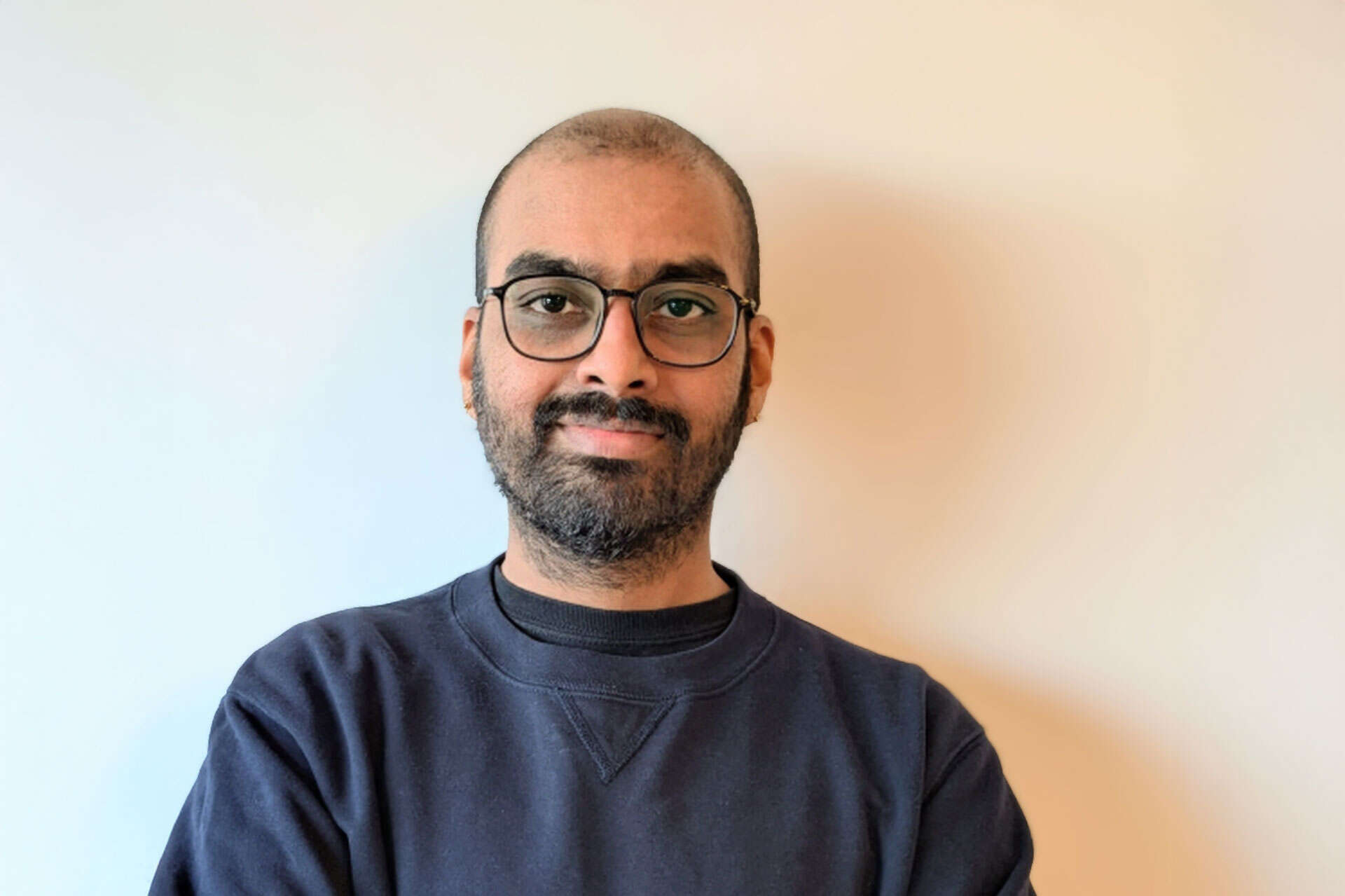
Ravi Sharan has followed the PhD Programme at Faculty of Engineering and Science, specialisation in Information and Communication Technology, scientific field Mobile and Wireless Communications.
- Trial lecture starts at 10:15
- Public defence starts at 12:15
Title of trial lecture: "Semantic Communications for 6G"
Disputation chair: Dean, Anne Cathrine Gjærde
Assessment committee:
- First opponent: Professor Sabita Maharjan, UiO, Oslo
- Second opponent: Professor Mikael Gidlund Nøland, Mid Sweden University, Sverige
- Chair of assessment committee: Professor Lei Jiao, UiA, Norge
Supervisors in the doctoral work:
- Main supervisor: Professor Baltasar Enrique Beferull Lozano, UiA/SimulaMet
- Co-supervisor: Professor Sibi Raj B Pillai, IIT Bombay
- Co-supervisor: Professor Tim Alexander Majchrzak, UiA
Summary of thesis
In the next-generation wireless network (NGWN) applications, it is not enough for data to arrive quickly; it needs to arrive continuously fresh. This becomes even harder when you have massive numbers of end-user devices competing for network resources — like in the Internet of Things (IoT) where the wireless network simultaneously serves multitude of sensors. This PhD thesis addresses a fundamental challenge in modern wireless networks: keeping information fresh and timely at end users' devices. Rather than just measuring how fast data travels, this research work focuses on Age of Information (AoI) — which indicates how "stale" the data has become by the time it reaches the user. More importantly, this PhD thesis focuses on the following two practical scenarios, where:
a) the wireless network serves multiple users equipped with a single antenna to deliver real-time traffic updates, and
b) extended reality (XR) users equipped with multiple antennas communicate their data simultaneously to the wireless network.
Since the corresponding mathematical problems are extremely difficult to solve perfectly (non-convex and NP-hard, in technical terms), they are simplified using smart algorithms to find good solutions quickly. A key aspect of this research work is that the proposed solutions consistently beat existing methods at keeping information fresh while also balancing other network performance requirements. Finally, this research directly benefits NGWN applications such as autonomous vehicles, smart cities, and immersive reality experiences — where information freshness can be as critical as conventional data rate.
What to do as an online audience member
The disputation is open to the public. To follow the trial lecture and the public defence online, register on Zoom.
We ask online audience members to join no earlier than 10 minutes in advance. After these times, you can leave and rejoin the meeting at any time.
Opponent ex auditorio:
Deadline for the public to pose questions is during the break between the two opponents. Questions ex auditorio can be submitted to Kristine Evensen Reinfjord.
Contact person

- kristine.reinfjord@uia.no
- Phone
- +47 37 23 30 14