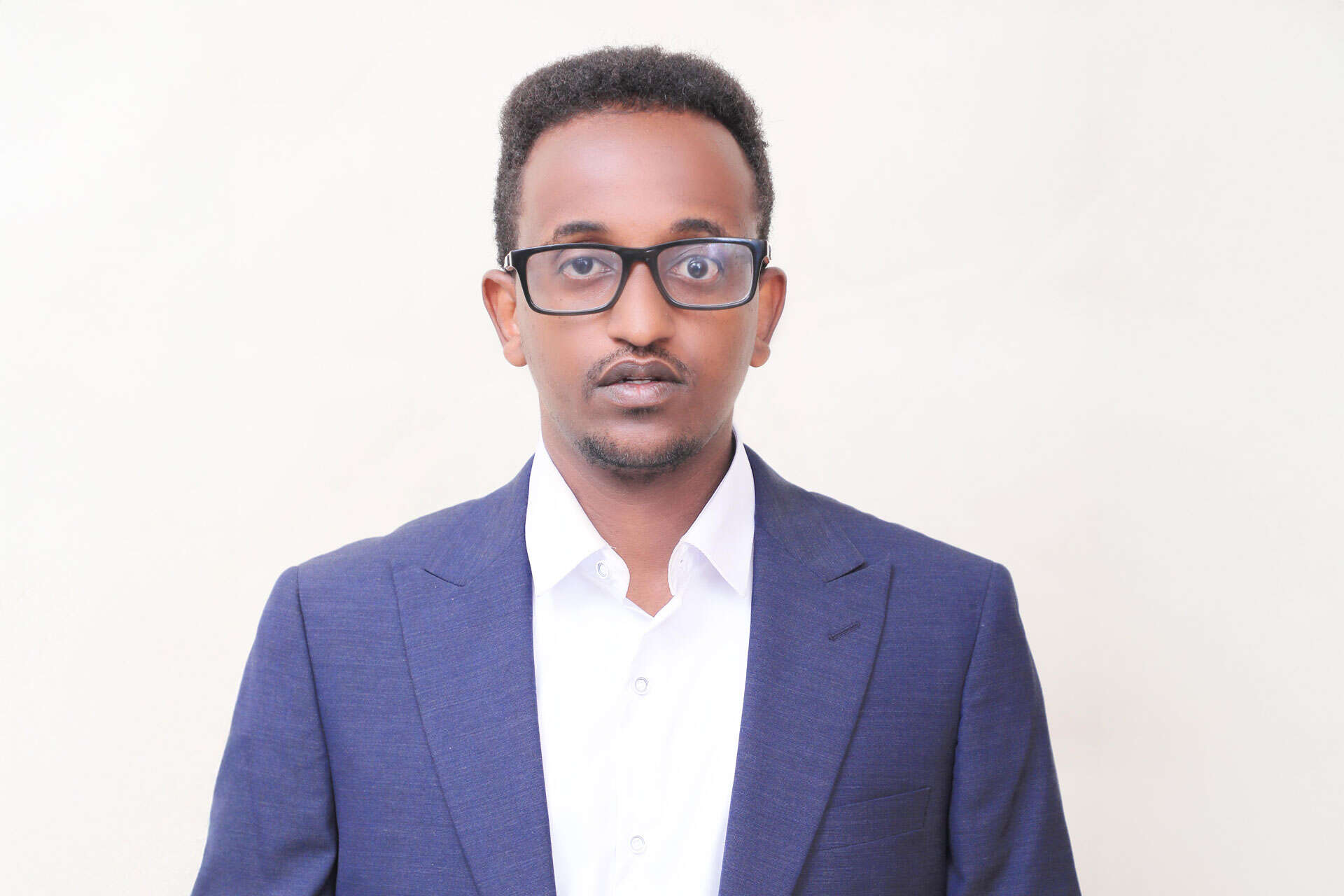
Mebaye Belete Mamo has followed the PhD Programme at Faculty of Engineering and Science, specialisation in Specialisation in Engineering Sciences, scientific field Mechatronics.
- Trial lecture starts at 10:15
- Public defence starts at 12:15
Title of trial lecture: Learning-based control of robotic systems: Opportunities, limitations, and integration with model-based stability guarantees
Disputation chair: Zhiyu Jiang
Assessment committee:
- First opponent: Professor Jouni Mattila, Universitetet i Tampere, Finland
- Second opponent: Professor Kristin Y. Pettersen, NTNU, Norge
- Chair of assessment committee: Professor Henrik Kofoed Nielsen, UiA
Supervisors in the doctoral work:
- Main supervisor: Professor Andreas Prinz, UiA (substitute supervisor)
Summary of thesis
Robots are everywhere—from factory floors to high-tech laboratories—helping produce goods faster, safer, and with greater precision. But as industries push for more efficient and sustainable systems, engineers face a tricky challenge: how to make robots lighter and more agile without sacrificing accuracy and stability.
This PhD research tackles that problem head-on.
Traditionally, robotic arms are built to be stiff and heavy to ensure precise movements. However, heavy robots consume more energy, cost more to build, and can pose safety risks when working near humans. Modern engineering is shifting toward lighter, more flexible robotic arms that are safer, faster, and more energyefficient. The downside?These flexible structures tend to vibrate and bend, making them harder to control accurately.
This research focuses on a special class of robots known as flexible-link manipulators—robotic arms designed with lightweight, bendable links. While promising, these systems are notoriously difficult to model and control due to their complex motion and vibration behavior.
To address this, the study develops advanced mathematical models that capture how these flexible robotic arms move and deform in real time. By incorporating more realistic physical effects—such as how the links rotate and vibrate—the models significantly improve prediction accuracy.
Building on these models, the research introduces control strategies that allow the robot to move precisely, even while its structure flexes. Two key approaches are explored:
- One method enables the robot to follow desired paths with high accuracy
- Another advanced control technique actively suppresses unwanted vibrations while maintaining precise motion
These methods were tested through simulations and real-world experiments, demonstrating strong improvements in performance. Such advancements could impact industries ranging from manufacturing and healthcare to space exploration—anywhere robots need to be both powerful and adaptable.
In short, this research helps unlock the full potential of flexible robots, paving the way for smarter machines that are not just strong – but also agile, efficient, and precise.
What to do as an online audience member
The disputation is open to the public. To follow the trial lecture and the public defence online, register on Zoom.
We ask online audience members to join no earlier than 10 minutes in advance. After these times, you can leave and rejoin the meeting at any time.
Opponent ex auditorio:
Deadline for the public to pose questions is during the break between the two opponents. Questions ex auditorio can be submitted to Kristine Evensen Reinfjord.
Contact person

- kristine.reinfjord@uia.no
- Phone
- +47 37 23 30 14