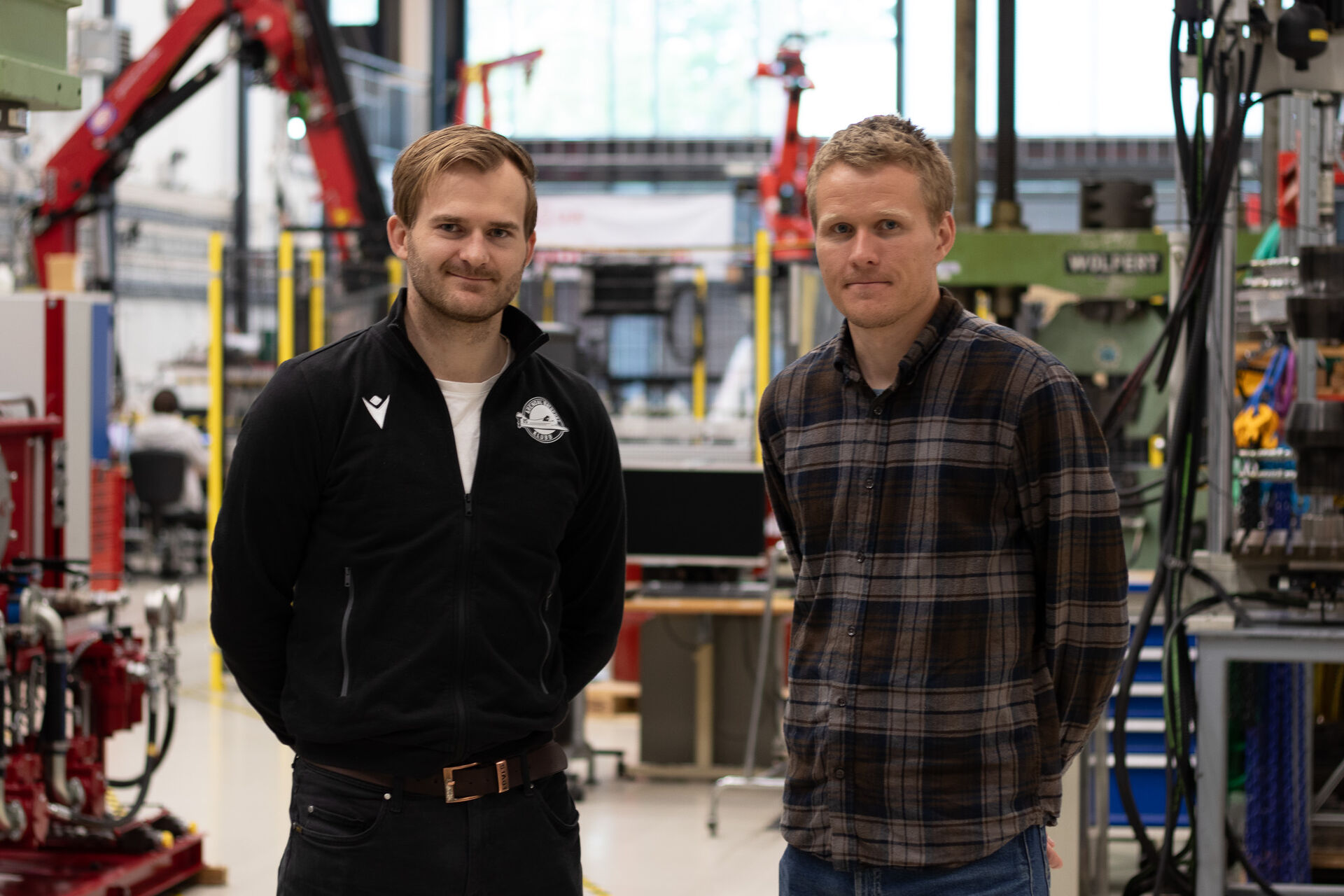
"We are very pleased to receive this grant. Most of the money will go towards developing measurement equipment for a leg prosthetic," says Fredrik Vatne Rylander.
Rylander and Østerholt founded MTP Engineering in Grimstad during their studies. Rylander is studying industrial economics and Østerholt is studying mechatronics. Both completed their master's degrees this June.
The students have taken an interest in prosthetic technology.
Rylander explains that many people experience reduced skin sensitivity after amputation, which can result in skin issues and pressure sores when using prosthetics.
"Individuals with prosthetics have a 65 per cent higher chance of developing sores than others," he says.
The students are therefore developing a small gauge that can be embedded in leg prosthetics. The gauge will detect changes in pressure and notify the user.
Prevent downtime
The gauge is small enough for users to carry with them. Other gauges on the market are stationary and do not capture as much data as one that is continuously connected throughout the day.
"The body changes throughout the day, which can cause the limb to press further into the prosthetic, leading to pain," Rylander says.
By receiving alerts from the gauge, users can remove or adjust the prosthetic to prevent injury.
Helping more people stay employed
The students believe the new technology can assist many people. They report that 300,000 people in the EU lose an arm or a leg each year.
"Our goal is to reduce the number of people who rely on disability benefits. If we can help even a few remain employed, society will save a lot of money," says Rylander.
Affordable arm prosthetics for the world
MTP Engineering is also working on another prosthetic project. Lars Østerholt explains that some of the funds received will be used to further develop cost-effective arm prosthetics that everyone can afford.
"In Norway, advanced arm prosthetics can cost several hundred thousand kroner, which people in poorer countries cannot afford," says Østerholt.
The arm prosthetic will be able to pick up signals from the muscles. These signals control the fingers.
"We aim to mass-produce these without special adjustments, so they suit many people, making them more affordable," Østerholt says.
UiA education provided the tools
Their education at UiA has been key to Østerholt and Rylander's success. At the university, they learned programming, mathematics and engineering.
"We learned to quickly transition from an idea to a working product, which is why we managed to create a prototype so quickly," Østerholt says.
UiA Nyskaping assists staff and students in bringing innovative ideas to life. Østerholt and Rylander received help from them when applying for funding and setting up their company.
"We greatly appreciate the assistance we received. Without it, we wouldn't have been able to get funding from Innovation Norway," says Østerholt.
Their goal is to have the pressure gauge for leg prosthetics on the market within two years. The students hope to start making money from the product before the project concludes in 2027.