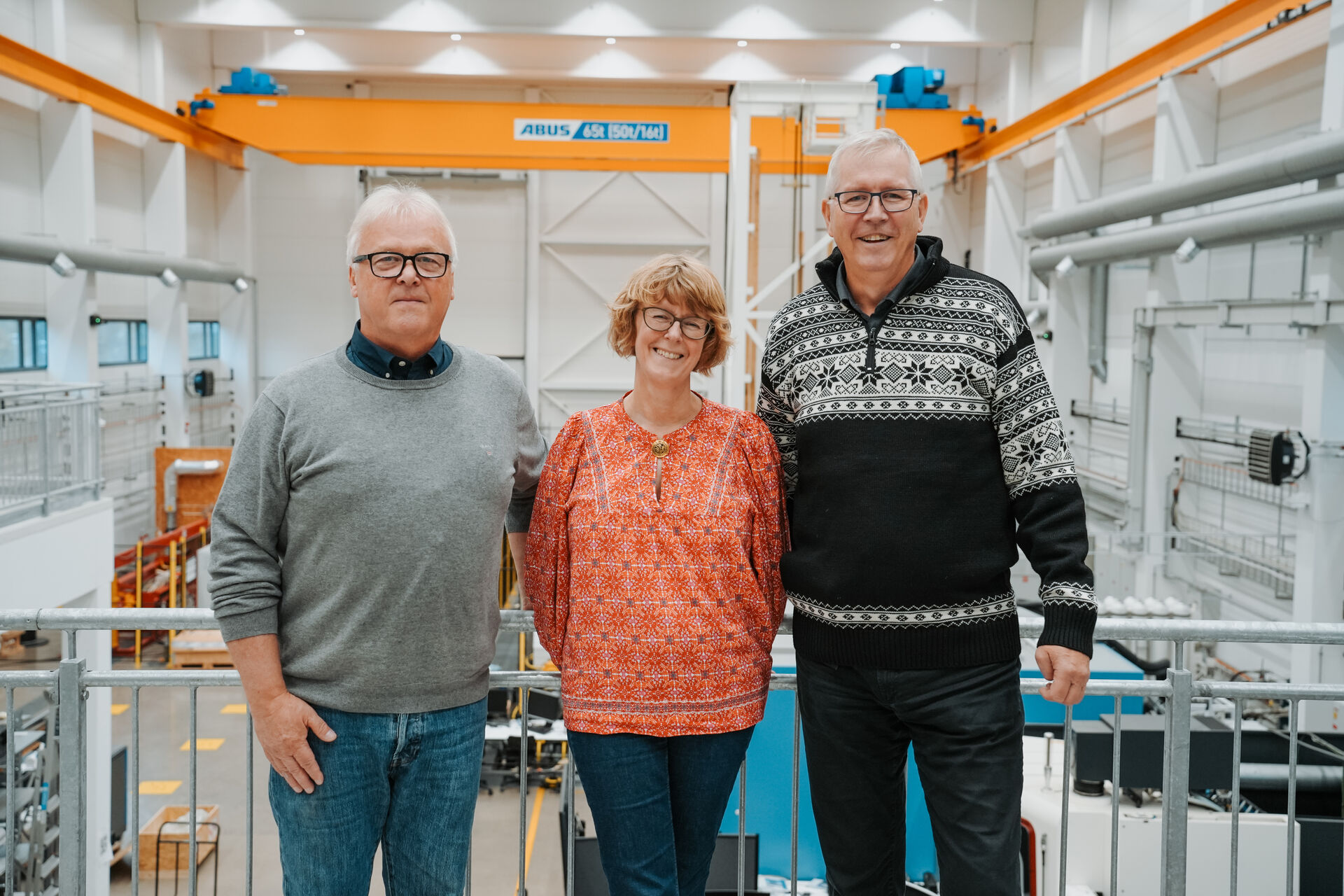
"We aim to contribute to developing and improving technology across offshore industries such as offshore wind, oil and gas, and shipping. Our goal is to work in close cooperation with the industry."
That's according to Kjell G. Robbersmyr, professor of engineering at the University of Agder (UiA). He is project director for SFI LEO (Centre for Research-based Innovation: Life Extensions of Offshore Assets).
May get NOK 242 million funding
UiA is leading the project with the aim of establishing a research centre to promote greener industries, both on land and at sea. The recently submitted application could receive over NOK 85 million in collaboration support from business and industry, and NOK 96 million from the Research Council of Norway.
The total budget could also exceed NOK 242 million. But first, the application must go through the stiff competition for SFI funding from the Research Council of Norway.
"Our ambition was 200 million, so this shows a strong determination from the business community to support our centre. These funds will contribute to greener development nationally," adds research adviser at UiA, Anne Solvang Salvesen.
Read more about the SFI scheme here
Aiming for 2026 launch
So far, 26 stakeholders, both nationally and globally, have signed up to join the team.
To achieve the goal of becoming an SFI, collaboration is absolutely crucial. This will also ensure an effective exchange of knowledge between industry and academia.
Ellen Nordgård-Hansen, a senior researcher at NORCE, emphasises the centre’s vision:
"The aim is to establish good collaboration with all our partners. From new knowledge to new technology and concrete solutions," she says.
The companies involved in the project will participate by providing financial support, as well as contributing equipment and their employees' time and skills. If the SFI LEO project is granted approval, it will launch in 2026.

Reducing risk and costs
But how exactly will the project make a difference in the offshore industry?
According to Robbersmyr, the centre will deliver innovative solutions for critical equipment and facilities offshore and installations onshore. This will simplify maintenance and reduce the risk of damage to both people, the environment, installations and ships.
"By carefully monitoring the equipment, we can control its use and make educated decisions about extending the life of the equipment. This will not only reduce the risk of damage, but also lower operating costs," he says.
The project has brought together several large and prominent stakeholders, but remains open to collaboration with new companies.
Facts about the SFI LEO project
- UiA is applying to establish a Centre for Research-based Innovation: Life Extensions of Offshore Assets, SFI LEO for short.
- UiA manages the project in collaboration with NORCE Research, NTNU Ålesund, the University of Stavanger (UiS) and the Institute for Energy Technology (IFE).
- The application process is two-part: The application for step one was submitted to the Research Council of Norway on 18 September, where the intention behind the centre and the collaboration with all business partners was presented.
- Out of around 100 applications, 30 will be selected to move on to step two, where a more comprehensive and detailed application will be submitted in June 2025.
- If the SFI LEO project is granted approval, it will become one of minimum eight new SFI centres in Norway, with a planned launch in early 2026.