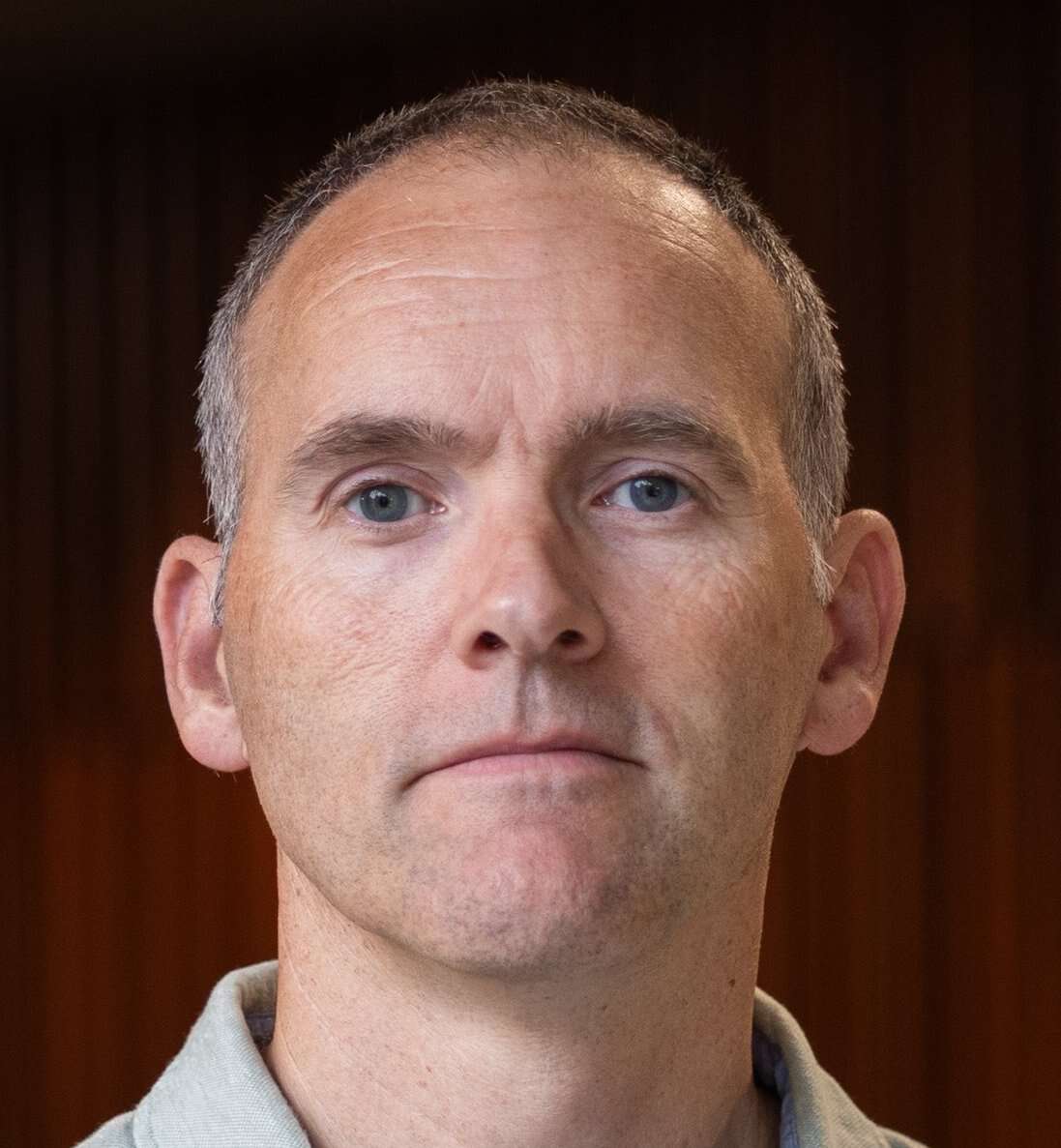
Background and experience
I am an ecologist specializing in marine and freshwater systems, with a particular focus on fish ecology, bioacoustics, and telemetry-based approaches.
I hold an M.Sc. in Biology and a Ph.D. in Ecology (2006) from the University of Oslo. Following my Ph.D., I worked as a researcher at the Centre for Ecological and Evolutionary Synthesis (CEES) and completed a postgraduate teaching qualification. I have been a at the Department of Natural Sciences at UiA since 2009.
Areas of responsibility
I currently serve as Deputy Chair of the Centre for Coastal Research (CCR) and Deputy Head of the Department of Natural Sciences.
Teaching
I teach and contribute to several courses at UiA, including:
BIO112 – Introduction to Biology
BIO206 – General Ecology
BIO300 – Bachelor’s Thesis in Biology
BIO413 – Coastal Benthic Ecology
BIO414 – Pelagic Ecology
BIO415 – Study Design, Data Analysis, and Reproducible Science
My teaching emphasizes quantitative skills, inquiry-based learning, ecological understanding, and reproducible science.
I supervise bachelor’s and master’s students every year, usually in connection with my ongoing research projects. Prospective students are very welcome to get in touch if they are interested in a thesis within my research areas.
Research
I primarily study marine and aquatic ecosystems. My work centers on fish ecology and integrates multiple methodological approaches, including passive acoustic monitoring, acoustic telemetry, and genetics.
Bioacoustics and Ecoacoustics
A major part of my research uses Passive Acoustic Monitoring (PAM) to study sound production and communication in fish and, to some extent, amphibians. My research spans both bioacoustics and ecoacoustics and addresses:
Why, how, and when animals use sound
How acoustic communication influences population ecology and evolution
How sound can be used to monitor biodiversity and ecosystem state
The impacts of anthropogenic noise on individuals, populations, and ecosystems
These approaches generate large volumes of data, and I collaborate with colleagues to develop and apply deep learning tools for efficient data processing and analysis.
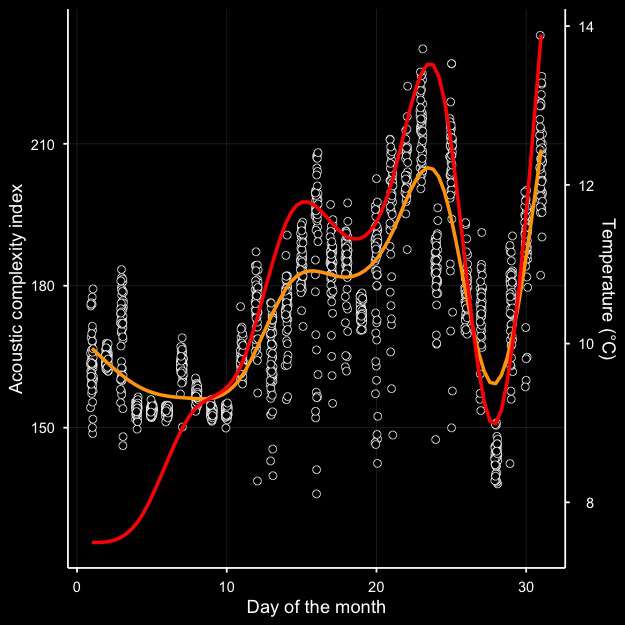

Left: Sea surface temperature (red) and Acoustic Complexity Index (ACI - a measure of activity of soniferous species - orange) through the month of May 2023 in a coastal ecosystem in Southern Norway. ACI is calculated individually (white dots) for each 1-minute sound recording, between 12.00 and 13.00 every day. In periods like this, when the water temperature changes relatively quickly between 7 and 14 degrees, the activity of soniferous fish, and therefore the soundscape as a whole, are strongly affected by the ambient temperature. The data were recorded at 3 meters depth.
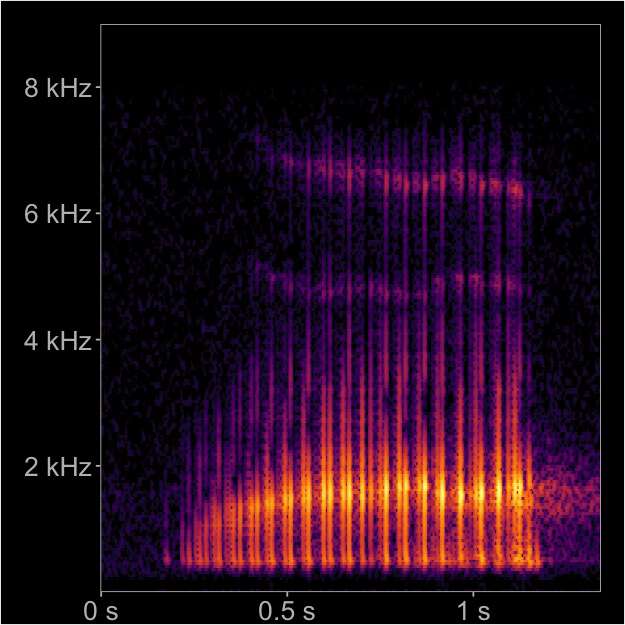
Right: A spectrogram of the mating call of a male pool frog (Pelophylax lessonae) recorded in Arendal, Norway June 1, 2020. The males call intensively, to attract females and to intimidate competing males, during the spawning season in May and June, often producing large choruses, and sometimes this can be heard more than a kilometer away.