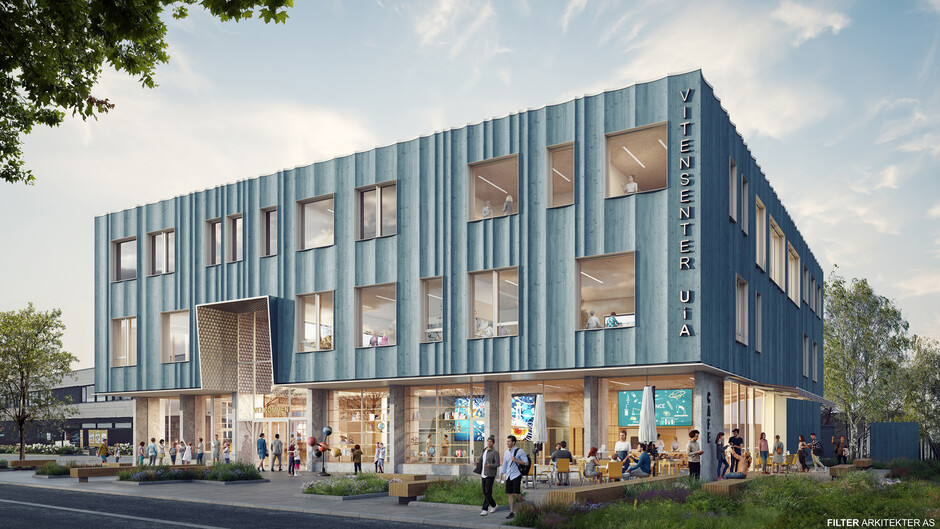
Construction is well underway, and in spring 2026 a brand-new science centre will open on Campus Kristiansand, right next to Spicheren, the Sørlandet Knowledge Park, and not far from the Natural History Museum and Botanical Garden.
At Vitensenteret Kristiansand UiA, you will find the Science Centre Sørlandet, which is relocating its Kristiansand premises from the city centre. UiA will also occupy parts of the building, and together we aim to create an attractive meeting place for children, young people, businesses, organisations, staff, and students.
What will Vitensenteret contain?
Vitensenteret Sørlandet will bring all its activities into the new building and offer exhibitions, learning spaces, a stage, and a wide range of exciting experiences from the world of science.
UiA will occupy parts of the building that can be used for:
- Teaching and dissemination
- Research communication
- Interdisciplinary collaboration
- Cooperation with external partners
- Student projects and coursework
A dedicated café/restaurant will also be established in the building, along with opportunities for shared use between UiA and Vitensenteret.
Layout of the building:
1st floor:
- Vitensenteret Sørlandet exhibition and activity area
- Lunch/teaching room (capacity: 50 children / 30 adults)
- Social zones and shared spaces
- Amphitheatre (capacity: 70 children / 50 adults)
2nd floor:
- Vitensenteret Sørlandet exhibition area
- UiA dissemination space (80 m²) – featuring the opening exhibition “The Brain Journey” in collaboration with UiA’s neuroscience research environment
3rd floor:
- Vitensenteret Sørlandet office area
- UiA offices, 3 group/meeting rooms, and a project room
- Social zones and shared areas
The 3rd floor also includes a workshop consisting of:
- Laboratory/teaching room (capacity: 42 adults)
- Teaching room (capacity: 54 adults)
- Makerspace featuring 3D printing, laser cutting, soldering, woodworking, textile work, printers, etc. (capacity: 45 adults)
Examples of activities and collaboration
Content and concept development is already well underway and will include:
- Science communication through exhibitions, lectures, and presentations
- Educational programmes for kindergartens and schools in the region
- Teaching, workshops, hackathons, laboratories, and project spaces for students
- Interdisciplinary projects with internal and external partners
- Physical exhibitions and installations
- Outreach to new target groups, including researchers, educators, research centres, and research groups
More information will follow.