Purpose
The SAKO project aims to develop new knowledge on how service robots can be utilized as work support in municipal nursing homes. The project will identify and evaluate which tasks are suitable for service robots and how they can help reduce the workload for healthcare professionals. Through testing, adaptation, and collaboration, the project will also develop recommendations for the effective and sustainable implementation of service robots in the Norwegian healthcare sector.
Project description
The SAKO project is a collaboration between the municipalities of Arendal, Grimstad, and Risør, as well as research environments at the University of Agder and Lappeenranta-Lahti University of Technology. The project addresses a critical challenge in the healthcare sector: the shortage of healthcare personnel and the increasing workload in nursing homes. By using service robots for routine tasks such as internal logistics, laundry handling, and equipment transport, healthcare professionals can free up time for direct patient care.
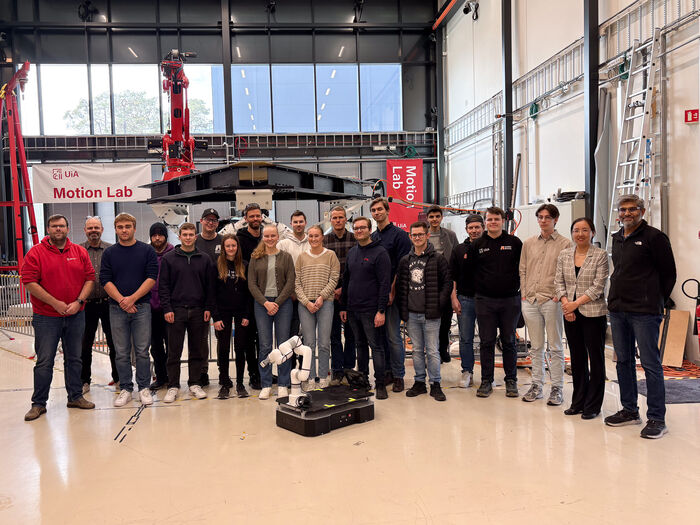
Through a systematic approach, the project will map the needs of nursing homes, test robotic technology in both laboratory and real-world settings, and evaluate its effects on the work environment, patient care, and healthcare economics. The project also includes extensive user involvement with employees, patients, and relatives to ensure the technology meets their needs. The results will contribute to the development of models for implementing service robots that can be adapted both nationally and internationally.
Results
The SAKO project is in its early stages, and it will take time before the final results are ready. The project spans a four-year period and will conclude in 2029. Along the way, we will share preliminary findings, including experiences from the implementation and testing of service robots, as well as results from surveys and user studies. The goal is to provide new knowledge that can contribute to better resource utilization and improved quality in healthcare and social services.