Strategic Framework 2025-2028 School of Business and Law
Who we are
The School of Business and Law is a publicly funded university-based business school, offering business and law programmes at the bachelor’s and master’s level, executive education, as well as a well-known and reputable PhD programme in International Business. The School is research-based, conducting relevant basic and applied research in collaboration with relevant partners in academia, industry and the public sector. Our academic culture is based on academic freedom, inclusion and diversity,international collaboration, student engagement and a positive organizational environment, in addition to having a strong belief in co-creation of knowledge.
Context
The national framework is that there is no tuition fees for Norwegian and EU students and that there is a common regulatory framework for the publicly funded higher education sector. In the years to come, it is expected that the higher education sector will experience lower public funding, as well as structural changes due to smaller cohorts of students and new modes of teaching, including AI. This development demands both stronger internal prioritization and a higher portion of international students, also from outside EU, in addition to increasing externally funded research and programmes. In addition, there are greater expectations from stakeholders to both address and solve societal challenges, sustainability, inter-disciplinarity, innovation, AI and internationalization.
Position
The School of Business and Law is currently one of three internationally accredited business schools in Norway, and the only university-based accredited school. It positions itself among top three in Norway based on publishing records, accreditation and internationalization, and provides reputable research in selected areas. Also, it has both business and law in its portfolio, offering possible positive synergies.
Characteristics
The School is international, with a strong profile in International Business, a large number of international staff, and a highly dedicated academic environment. The School offers high quality programmes within Business, Finance, Economics, Management, Law, Marketing, Accounting and Auditing, and Industrial Economics, combining core disciplines and relevant areas in demand from society. Also, the School has strong ties to industry, working life and other faculties at the university, close national and international partnerships compact campuses close to the city centre, and closeness between academic staff and students. The School is not, however, yet sufficiently visible and recognized on the national stage.
Framework for the strategy
Vision:
Co-creating for tomorrow's knowledge
Values:
Openness - Trust - Academic quality - Respect
Mission statement:
We educate innovative and responsible professionals and leaders with a global mindset
What we do
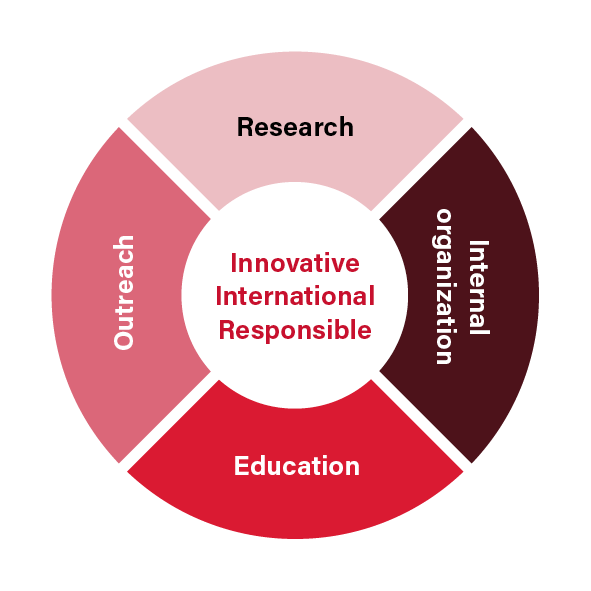
The School of Business and Law fulfills the three main parts of the social mission being: Education, Research and Outreach, and offers an effective, well-organized and inclusive internal organization.
In addition, the School bases its activities on the following three pillars: Innovative, International and Responsible.
The strategic document is organized according to the three areas in the social mission in addition to viewing internal organization as an important part of this. Also, the three pillars in the mission statement underpins the overall strategy and is an integrated part of the School’s operation and activities.
Overall goal for the School of Business and Law:
In 2028, the School is nationally recognized among top three business schools in Norway, it has a solid reputation internationally within multiple areas, has several experts in high demand, and is a preferred partner in externally funded projects.
Education
Overoall goal: In 2028, the School continues to offer contemporary and high quality study programmes at all levels, attracting highly motivated students proving a high degree of employability and critical thinking.
Supporting strategic goals
- One experiences that more than 70% of the students complete within the expected time frame, and 80% receive relevant job offers within 12 months after graduation of their master’s degree.
- One continues to attract qualified and motivated applicants, with a 20% increase of own students pursuing their master’s degree at the School, an increased number of the national students are from outside the region, and the School has 30% more international students.
- Building on core disciplines, the School has a robust portfolio that meets future expectations and competence needs, including a new PhD programme in Law and a new PhD specialization in Accounting & Finance, and it has a competitive Executive Education with a national position.
- Responsible business practices and sustainability are an integral part of all programmes, whereas the use of artificial intelligence is integrated in all core subject areas.
- Students experience a learning environment characterized by different pedagogical
approaches and evaluations, exposure to academic reflection and critical thinking,
international perspectives, and proximity to the professional world when relevant. - The student environment is characterized by a strong and open relationship between students, academic and administrative staff, including excellent opportunities to be involved in social and scholarly activities, as well as student politics. Also, new students experience a robust onboarding system.
Research
Overall goal: In 2028, the School is a research active, ambitious and collaborative business school, attracting top tier scholars and research partners who conduct impactful research that finds practical applications, guided by principles of responsible research and high standards of research ethics.
Supporting strategic goals
- The School fosters a supportive and inclusive research environment where academic staff at all career stages especially targeting junior researchers, are encouraged to engage in research, development, and innovation activities that connect with education and outreach initiatives.
- The amount of relevant research with high scientific and societal impact has increased, where both publication outcome and outlets are in line with comparable schools, and still among top three in Norway. This is measured both in publication points and quality of outlet, but also proven by citations and its effect on policy making and implementation.
- The School is known for its robust research environment; it has nurtured thought leadership in selected areas and it is an attractive research partner for other academic institutions, businesses, government and society at large.
- Academic staff have a solid understanding of how artificial intelligence applies to their areas of expertise, actively using AI as a toolkit in their research, and explore innovative applications to drive advancements in their fields.
- The School has strengthened research activities by generating external research funding from credible national and international sources, with at least five ongoing EU projects.
- Much of the research is interdisciplinary and conducted in collaboration with strong external partners, emphasizing co-creation, dissemination and practical application of knowledge.
Outreach
Overall goal: In 2028, the School is visible and connects well with key target groups regionally, nationally and internationally, and has many well-known and preferred experts within several areas.
Supporting strategic goals
- Students actively participate in outreach activities through internships, co-creation projects and student-led initiatives, enhancing the School’s visibility and community connections.
- The School’s communication, marketing and alumni activities are well planned, strategic and comprehensive, including a clear presentation of experts.
- The Executive Education Centre proves stringent scholarly management and presentable facilities connecting the School to external partners, contributing to the Schools visibility.
- Impact on society is enhanced by long-term strategic partnerships with high caliber national and international schools and universities for both teaching and research.
- To ensure relevance and visibility, the School has extended collaboration with relevant regional, national and international organizations. This is done through student internships, participation in industrial associations, incubators, clusters, boards etc.
- The Centre of Entrepreneurship acts as a Hub for contact with SMEs and investors, including entrepreneurship pedagogy, student and staff entrepreneurship, as well as outreach.
Internal organization
Overall goal: The School has an inclusive and open culture, based on trust and respect, nurturing creativity, quality and academic freedom.
Supporting strategic goals
- The School continues to focus on an organizational culture which emphasizes support and inclusion, nurtures diversity, and offers inspiration and motivation to academic and administrative staff.
- The School continues to develop relevant processes to recruit, and keep, high-quality scholars and highly competent staff members.
- The School adapts to post-pandemic realities by balancing flexibility with the benefits of physical presence, fostering collaboration and a sense of community.
- An inclusive, viable and sustainable language policy is implemented.
- Both academic and administrative staff have easy access to, and are offered training in, updated and relevant technology.
- Academic and administrative staff collaboraterespectfully and effectively, sharing information and working toward a shared purpose with a clear understanding of roles and responsibilities.
(Key initiatives and KPIs are clearly defined in an action plan, including yearly resource allocations)
Interdisciplinary areas at the university level
The School of Business and Law is committed to support and operationalize the interdisciplinary areas at the university level, and it is an integrated part of the strategic framework at the School. There are several areas where the School can contribute, with some examples being presented below.
Helalth, upbringing, education and living conditions
- Health Economics
- Health Law
- Analyses of effects of policy interventions to reduce social inequality
- Social innovation to improve living conditions
Art and culture
- Cultural Economics
- Project Management
- Service Innovation
- Legal questions (like IPR, AI and more)
Democracy and active citizenship
- Governance
- Emerging markets
- Sustainable capitalism
- Public Law and Human Rights
Technology, digitalization and societal preparedness
- New business models/innovation management/strategy
- AI in accounting, auditing and other financial and legal areas
- Changes in work environment/HR etc.
- New digital platforms in marketing etc.
Climate, environment and energy
- Circular economy, regulatory framework, EUs Green Deal etc.
- ESG-reporting & responsible investments, LCAs
- Public procurement
- Analyses of risk, profitability and law-related issues in the energy transition
Sustainable transformation and innovation
- Sustainable business models
- Entrepreneurship and alternative finance
- Business ethics and various legal issues
- Sustainable finance and various financial analyses