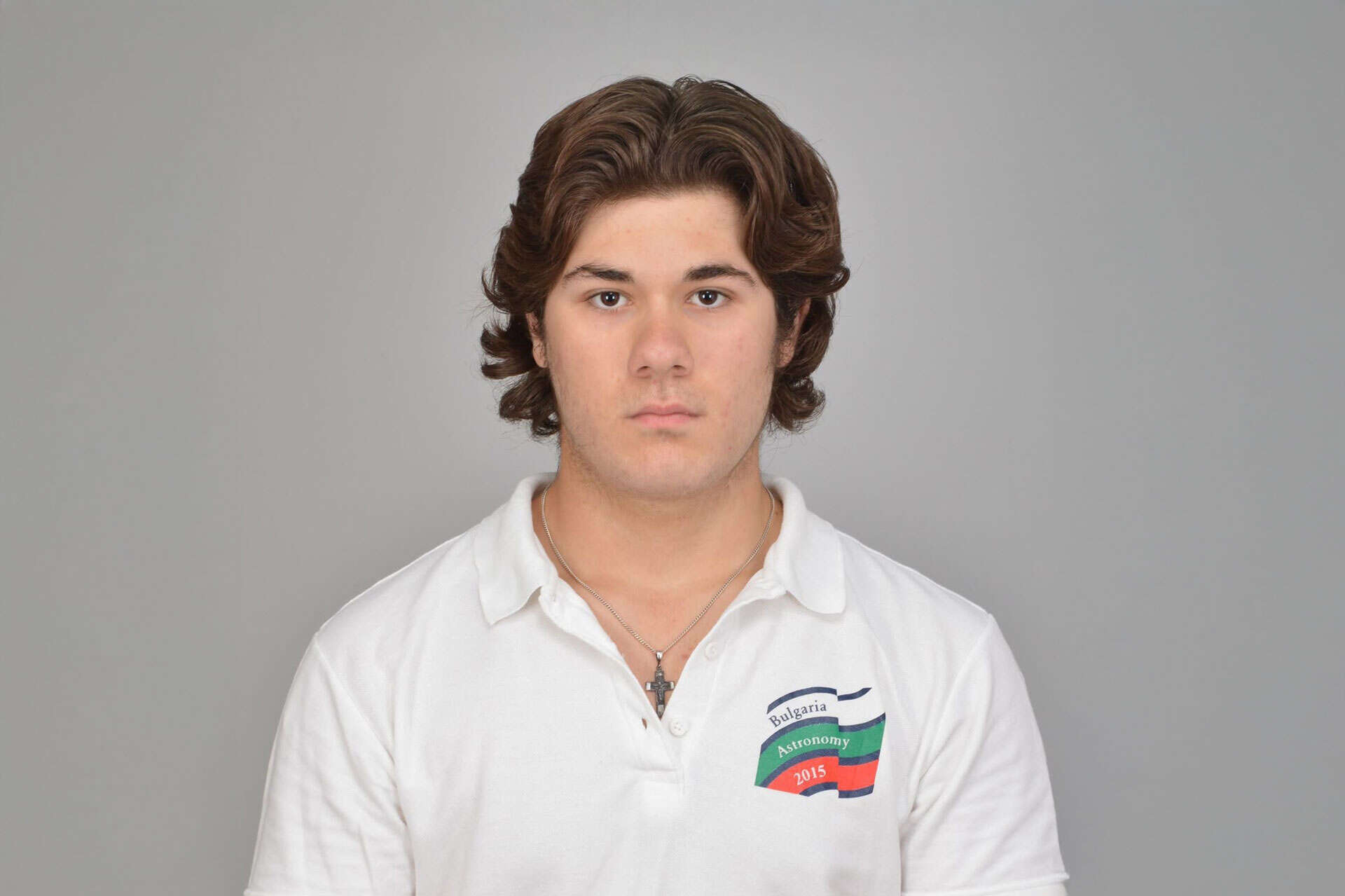
Feodor Svetlanov Konomaev has followed the PhD Programme at Faculty of Engineering and Science, Specialisation in Physics and Applied Mathematics.
- Trial lecture starts at 10:15
- Public defence starts at 12:15
Title of trial lecture: "Quantum materials for neuromorphic computing"
Disputation chair: Paul Svennevig
Assessment committee:
- First opponent: Professor Anna Dyrdal, University of Poznan, Poland
- Second opponent: Professor Jacob Linder, NTNU
- Chair of assessment committee: Professor Jing Zhou, UiA
Supervisors in the doctoral work:
- Main supervisor: Professor Kjetil Hals, UiA
Summary of thesis
This doctoral dissertation presents three research papers published in the journal Physical Review B on non-collinear antiferromagnetic spintronic phenomena and, more specifically, kagomé antiferromagnets. Two of these publications investigate the spin currents generated at the interfaces between a kagomé antiferromagnet and a normal metal due to the spin Seebeck effect, the amplification of which is the main focus of this work. The thesis commences with a general introduction into the field of magnetism and the properties of the kagomé lattice antiferromagnets.
Then, starting from a microscopic tight-binding Hamiltonian, we employed Holstein and Primakoff’s formalism to investigate for what regime of material parameters a kagomé antiferromagnetic monolayer exhibits topological properties, such as topological magnon states, which are confined to the monolayer’s edges. Our findings show that the presence and sufficient magnitude of an in-plane component of the Dzyaloshinski˘ı-Moriya exchange interaction is crucial for such states to occur. The particular value above which the kagomé antiferromagnet enters a well-defined topological regime was found to be about 30 % of the isotropic spin exchange interaction strength. Subsequently, an extended effective-action description of the magnons in this magnetic structure is presented, which includes terms dependent on the application of strain, in order to investigate how the spin chirality of the ground state can be switched between being positive and negative. It was discovered that an applied uniform strain of 7.75 % is sufficient to force the material to switch its chirality without the necessity of thermal fluctuations. Furthermore, a measurable, non-vanishing nett magnetisation, exclusive to the kagomé antiferromagnet with a negative spin chirality, was found, which can serve as a means for an experimental detection of chirality switching. The presence of this magnetisation was confirmed by treating the model microscopically. Finally, we consider how these two phenomena, namely spin chirality switching and the presence of topological magnons, influence the strength of the spin Seebeck effect spin current. In the former case, using the material parameters for Mn3Ir, we found out that the spin current has a constant y-component characteristic of the state with negative chirality, which can be measured in the adjacent normal metal as voltage arising from the inverse spin Hall effect. Moreover, we found a difference of about 81 % between the magneticfield-dependent z-components of the spin currents in the two chiral ground states, which can be measured through the anomalous inverse spin Hall effect. Lastly, in the case of the topological regime of kagomé antiferromagnet, we found that the topological edge state in the first band gap contributes to around 28 % of the total spin Seebeck current, implying that the presence of topological states sufficiently amplifies the spin current.
What to do as an online audience member
The disputation is open to the public. To follow the trial lecture and the public defence online, register on Zoom.
We ask online audience members to join no earlier than 10 minutes in advance. After these times, you can leave and rejoin the meeting at any time.
Opponent ex auditorio:
Deadline for the public to pose questions is during the break between the two opponents. Questions ex auditorio can be submitted to Kristine Evensen Reinfjord.
Contact person

- kristine.reinfjord@uia.no
- Phone
- +47 37 23 30 14