
When Motion Lab was founded, the primary goals were to create an advanced research infrastructure for offshore mechatronics.
The vision was to strengthen Norway's leading position in offshore technology through innovative research and collaboration with the industry.
In recent years, the research focus has evolved from traditional motion control to more advanced methods, including artificial intelligence (AI) and digital twins, to realize smarter and more efficient offshore operations.
This has been a natural development to meet the new challenges and opportunities that come with technological advancements and increased digitalization.

- What does this 10-year anniversary mean for Motion Lab?
-It is important for us to highlight the transition to an Intelligent Motion Laboratory by fostering stronger collaboration between Mechatronics at the Department of Engineering Sciences and the Top Research Centre Mechatronics (TRCM), as well as with the AI community at the Department of ICT and the Centre for Artificial Intelligence Research (CAIR).
We are also focusing on increased collaboration with several research groups, such as Engineering Structures and Construction and building materials, as well as renewable energy, says Daniel Hagen.
- How do you plan to celebrate this milestone?
- We are celebrating with a new website, but we are saving the big celebration for when we hopefully receive a positive response to our research infrastructure application from The Research Council of Norway in September. Then we plan to invite all partners and those who provided letters of support for the application to a workshop here at UiA to kickstart the Intelligent Motion Laboratory, Hagen continues.
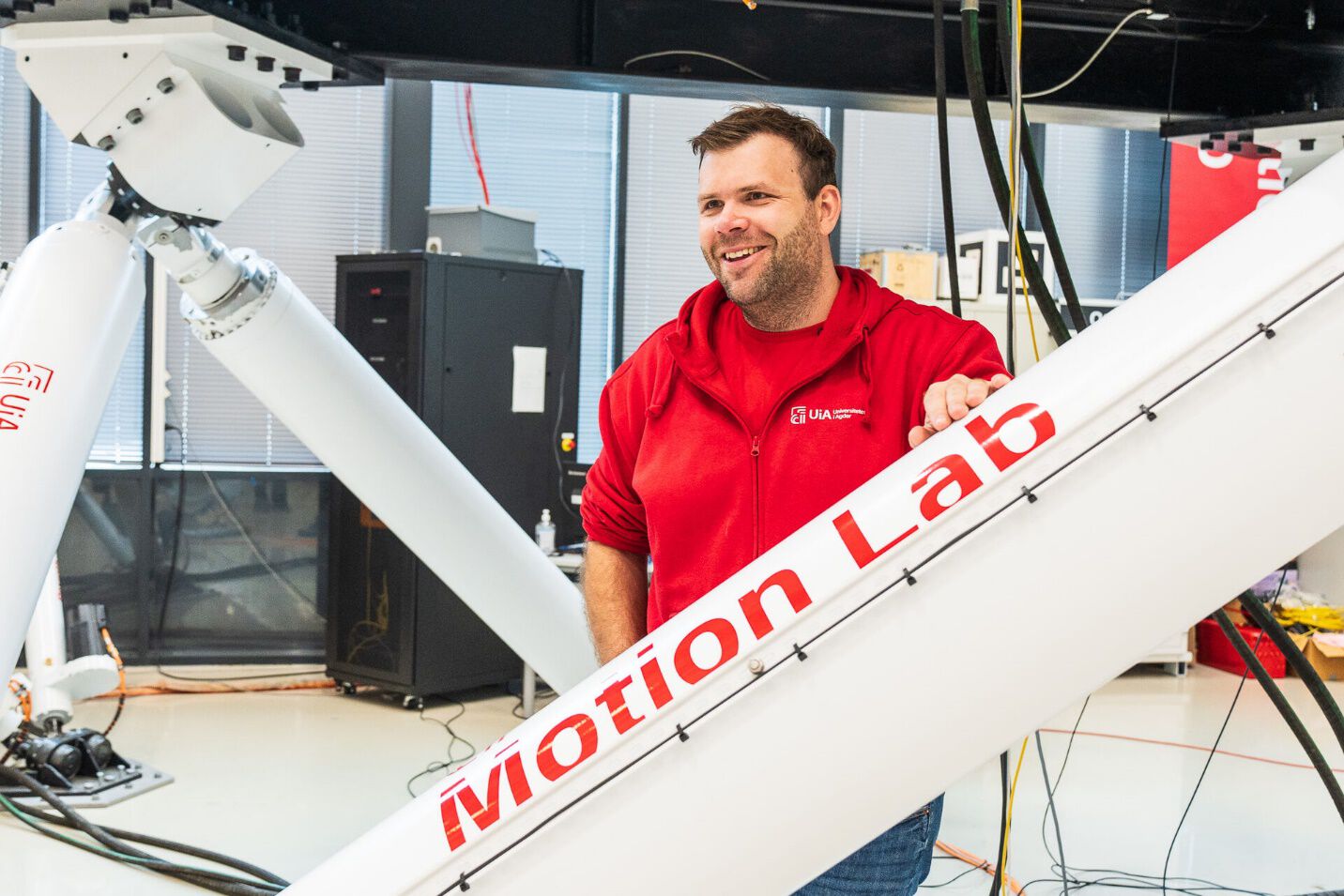
- How do you plan to continue developing or expanding research in the coming years?
- The work to elevate the lab to the next level involves acquiring state-of-the-art sensors to enable research on 3D perception in real time. We will also utilize AI supercomputers to enable research and development of intelligent algorithms (physics-informed AI/Machine Learning) and digital twins, ensuring that offshore equipment operates autonomously and as sustainably as possible. This means safely, energy-efficiently, and fast, to extend the operational window for marine operations, concludes Daniel Hagen.